A lump of carbon or poorly conducting wire (light bulb) is said to provide RESISTANCE in the circuit. This resistance property controls the electron flow or current.
HIGH resistance tends to mean small currents, LOW resistance tends to mean large currents for a given potential difference.
(The ultimate in high resistance is a break in the circuit, an OPEN circuit, the ultimate in low resistance is an accidental wire cancelling out the resistance - a SHORT circuit. The first stops the circuit from having current flow in the wire, the second flattens the battery! Both stuff up circuits.)
An object designed to control current is called a RESISTOR - these are very common devices in electronic gizmos like video recorders etc., and are commonly made of carbon or wire.
A number has been invented which measures how good or bad a conductor is, in other words just precisely what its resistance is!ƒ
Resistance = potential difference across conductor
current through the conductor
R = PD (V) / I
PD in volts , I in amps, R in ohms, &Omega
This particular formula, often written as
V = IR
is extremely useful. It is often known (incorrectly) as "Ohm's Law". So, having mentioned the gentleman, we had better look at his law.
OHM'S LAW
Georg Ohm was a schoolteacher back in 1827 when
he discovered his rule. This was well before the days modern meters with
easy to read pointers or scales. (Indeed these instruments depend on his
rule to work, so they shouldn't be used in any test of the rule! [ Why
not? ] ) He was promptly laughed at in his native Germany but recognised
in England which finally led to fame and a professorship.
His rule is "that the ratio of potential difference to the current flowing through a conductor is constant, providing all other influences such as temperature are kept constant."
That is, resistance is constant if the temperature is kept constant.
R = V/ I
is fixed, unchanging.
Now, it turns out (discovered much later) that this is true only for a very limited range of materials , mainly metals, and for a limited range of currents. BUT this is good enough for most circumstances and calculations.
Most materials do not obey the fixed resistance
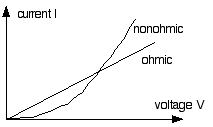
law! These are called NONOHMIC while the ones that do are OHMIC.
Graphically, this means as we raise the potential difference across the material, for ohmic resistors, the current rises proportionately, ie, a straight line through the origin. Nonohmic materials rise all sorts of strange ways!
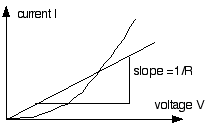
For ohmic materials, the resistance is the inverse of the slope of the straight line. Two forms of resistance exist for nonohmic materials, the inverse average slope and the inverse slope at the voltage of interest. The latter is far more interesting.
Resistance does depend on temperature!
Metals (copper, aluminium ...) - resistance usually increases with temperature.
Non metals (carbon, silicon, germanium...) - resistance usually decreases with temperature.
(This has interesting ramifications in light bulbs, silicon circuitry components etc. Old carbon filament jobs used to burn out easily because of "runaway" currents - as they heat up, the resistance drops, more current flows, they heat up more.......... )
(A smelly experiment with carbon your teacher may not approve of is to pass a current through a "lead" pencil for a while at a fixed voltage and monitor the current with time.)
Resistance depends on the type of material and the shape it is rolled into - its cross sectional area and its length. A fat short lump of copper presents far less resistance than a long thin wire even though the volumes may be the same.
R = ρl
/A ρ
= resistivity. This is a unique number for every material and determines whether it is a "good" or "poor conductor
l = length, A= cross sectional area
Using the formula
Example 1

In the above case, the light bulb has a resistance
of R = V / I = 1.5/ 1.2 = 1.25 ohms.
Example 2
A household light bulb of 60W at 240V has a resistance of 960 Ω. What current flows through the bulb when turned on?
Solution; V= IR so, 240 = I. 960.
I = 240 / 960 = 0.25 amps.
Ordinary light bulbs have a small current flowing through them at a high potential difference. (Think of this as a high water fall with only a very few rafts dropping over in a second.)