
PARALLEL CIRCUITS
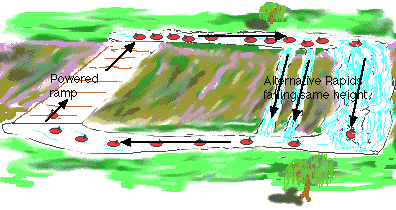
In this water circuit, rafts have the "alternative" of going down one of three chutes, each having the same height but each of different width. More rafts will pass down the fall of least resistance to the rafts' progress, but others will take the different paths.
KEY observations
* the heights of the rapids are the same
* the number of rafts entering and leaving the rapids per time remains the same
* the total number of rafts passing per time in all three drops is the same as the number leaving or entering.
The ramifications for electrical circuits are
* the supply potential difference, voltage, across each of the parallel resistances is common
* the total current entering and leaving parallel resistances is the same
* the sum of the currents in the parallel resistances adds to equal the current entering or leaving.
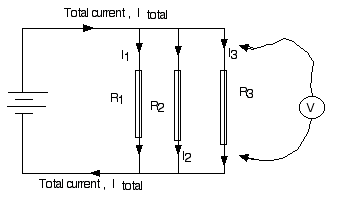
The above diagram is the electrical circuit equivalent of our rapids.
If we use the voltmeter across any of R1,R2 or R3, the value it shows will be the same.
also Itotal = I1 + I2 + I3
We can use these facts to find what single equivalent
resistance, Rtotal, will give the same current for the same
supply voltage. This is useful for further calculations in more complex
circuits.
Notice that this circuit has a great advantage
over the series circuit in that switches can be placed alongside each of
the resistances so they can be turned on and off separately. Household
circuits are of this design.
If the supply voltage remains fixed (which it does approximately for batteries and does closely for the 240V mains), then each additional appliance added in parallel will "demand" its own current additional to that already supplied to the other components.
More components, the larger the total current. (This does not fit the raft model at all well where the number of rafts is fixed so the total current appears fixed.)
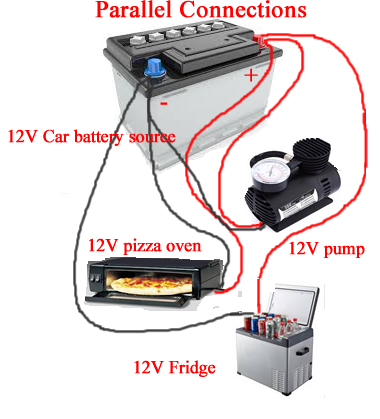
In the above parallel system, each of the Fridge, pump and oven are being separately operated by the same battery. But it is a parallel system! The connecting "flat water" sections are the terminals on the top of the battery.
eg The battery shown above is 12V and is hooked up as shown to the above three car accesories at your camp site; pizza oven (resistance 15Ω ) , fridge (resistance 20Ω ) and pump (resistance 200Ω ). What total current is being demanded of the battery?
Solution; Each component has a current through it decided by V=IR.
For the pump V = I1R1, I1 = 12/ 200 = 0.06 amps
fridge V = I2R2, I2 = 12/20 = 0.6 amps
oven V = I3R3, I3 = 12/15 = 0.8 amps
thus the total current supplied by the battery
= 0.06 + 0.6 + 0.8 amps = 1.46 amps
THE TOTAL EFFECTIVE RESISTANCE of parallel resistances.
Looking at the schematic diagram,
Itotal = I1 + I2 + I3
but , V = I1R1= I2R2 = I3R3 , from the equations of resistance and the observation that the same voltage exists across all.
Thus, I1= V/R1 , I2 = V/R2 , I3 = V/R3
we substitute in the top equation, so getting
Itotal = V/R1 + V/R2 + V/R3
= V ( 1/R1 + 1/R2 + 1/R3 )
Now V = Itotal Rtotal, so Itotal = V/Rtotal
Again substitute, and we get
1/Rtotal
= 1/R1 + 1/R2 + 1/R3
This is a very useful equation.
For two only parallel resistors, the formula can be simplified to Rtotal = R1R2/(R1 + R2)
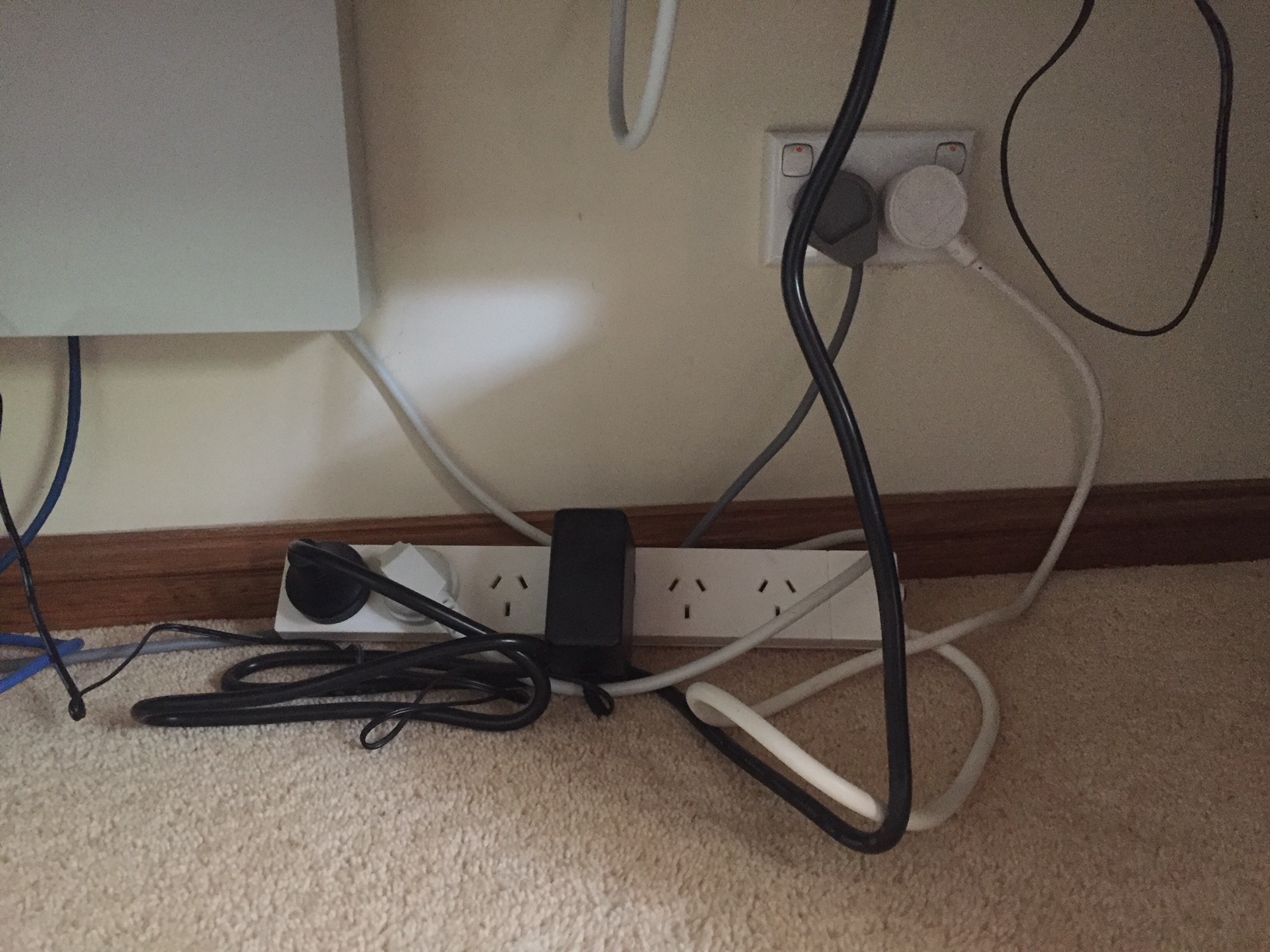
A power board is often used to create more power outlets in houses. Each socket is a new parallel branch so each new appliance has 240V across it but is still independently switchable.
Eg.
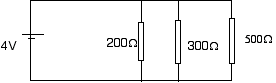
What current does the battery provide to the circuit?
Solutions.
Method 1
The system is in parallel, so the total resistance can be found to find the current.
1 = 1 +
1
+ 1
Rtotal R1 R2
R3
= 1/200 + 1/300 + 1/500
= (15 + 10 + 6)/3000 = 31/3000
Thus Rtotal = 3000/31 = 96.8 Ω
A single resistor of this value will replace the parallel system without changing the current drawn from the battery.
Thus the current drawn will be given by
I = V/R = 4/ 96.8 = 0.041 amps
Method two;
Calculate the current through each individual resistor with 4V across it and add. Try it .
Notice that the resistance DECREASES as more resistors are added in parallel. Each new channel for current means more current from the battery, the resistance in total must be decreasing. This is the opposite of series circuits where putting more in series decreases the total current, ie increases the total resistance.