We have all heard of "voltage" V, more correctly potential difference, PD. Most small modern batteries are supposed to be 1.5 or 9 volts. A car battery is slightly over 12 volts. The mains power is supposed to be 240 volts. So, what is this value, how different is it to current?
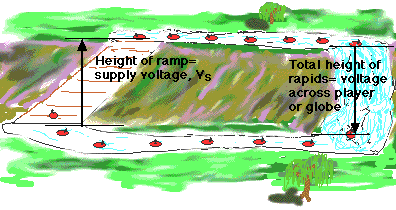
Remember the rafts - they had to be lifted to the top of the run by a continuously moving ramp or conveyer belt - they were given gravitational potential energy- which they then lost mostly in the rapid. The amount of energy would depend on the mass of the raft as well as the height ( Ep = mgh ). In fact the height alone, all other things being standardised (m,g) is a measure of the energy lost.
Electrons however, move because of the rules of charges, not gravity. They move because electrical potential energy is gained or lost. This is not easy to visualise because of our lack of experience with this energy so -we will translate them into terms of rafts and rivers.
The electrons are given electrical potential energy by the battery. They lose a tiny amount in the wiring because no wiring you will come across is perfect ( perfect wiring does exist - it is called a "superconductor") but loses the vast bulk of the energy in the player or lamp or refrigerator to make that device do the work you want - play music or whatever.
Now guess what the equivalent of the height of the ramp or rapid is for electrical circuits - THE "VOLTAGE" !
If we ignore the tiny drop in height across the tranquil water, the ramp height = rapid height. Similarly, if we ignore the tiny voltage across the hookup wires, the supply voltage = the voltage drop across our device.
( With bad or inadequate hookup wire, we find
that the energy loss is not ignorable in this wire, a voltage is noticeable
across the wire and the device doesn't get the full supply voltage. Guess
what happens to the hookup wire? - it gets hot!
Why?)
Potential
Difference = change in energy between two points in the circuit
amount of charge involved in measuring energy
PD (V)
= ΔEnergy of
Q
Q
unit of potential difference = joule per coulomb = volt
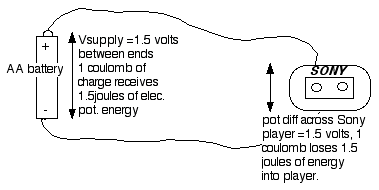
If we consider one electron, it receives an electrical potential energy of
1.5 x 1.6 x 10-19 joules of energy = 2.4 x 10⁻¹⁹ joules
in the AA battery which it discharges into the player. This ain't much but lots of electrons are involved.
What the player does with this energy is - drive motors, generate light, generate heat and if it is a mobile phone, generate light and sound - all having forms of energy.
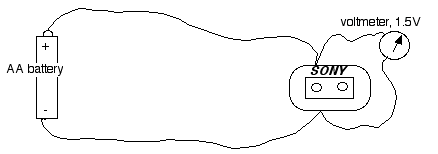
The instrument used to measure potential difference or voltage is the VOLTMETER. One uses it like a tape measure, one wire probe is placed on one side of the player, the other to the other side. ( A parallel arrangement.)
Rather than continuing to feed the energy into a complicated box like a CD player, for simplicity let us feed the energy into a much poorer conductor, like a bit of carbon - the centre of a pencil will do, or a light , or a radiator. (This is why at high school you always seemed to be mucking around with light globes.)
NOTE; - a CD player or a refrigerator or any other electrical device which does something is automatically a poor conductor compared with the connector wires! Poor conductors tend to warm up - lose energy - take the energy from the battery! If it was a good conductor, it would tend not to do much!