SERIES AND PARALLEL RESISTANCES
Very often components are linked together so that they influence each other. The extreme of this is a microprocessor such as in a typical computer which has literally millions of linked components on one piece of material - a "chip".
What we will spend some time looking at is linking a few components together to see what the effect will be. We can apply this knowledge to your own home’s wiring.
SERIES WIRING
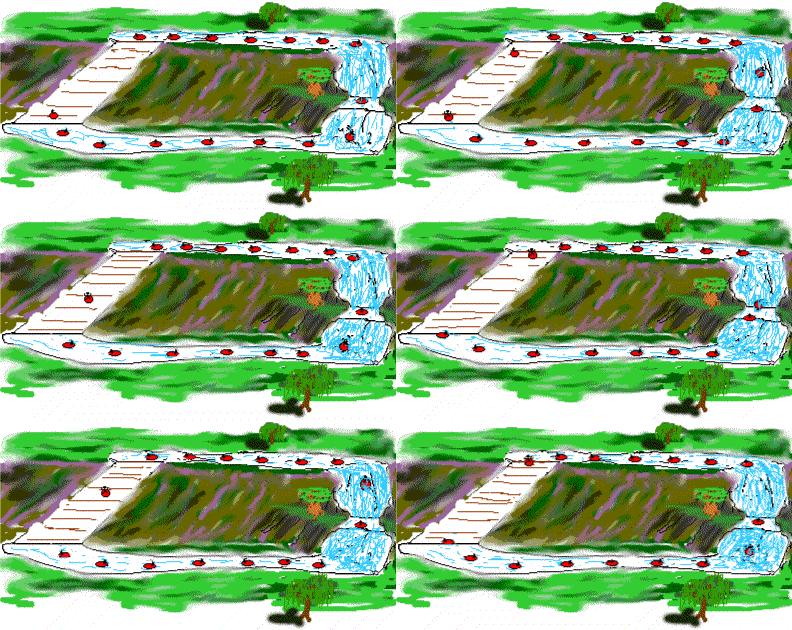
In this water circuit, the rapid is separated into two pieces, rapid 1, rapid 2 with a pool in between them. The rafts have no option but to go down one, losing a certain amount of energy, then the other to lose the rest of the potential energy.
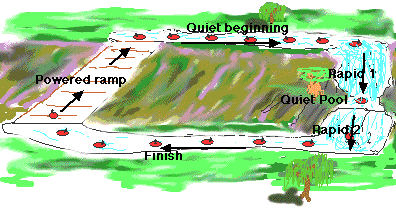
The number of rafts passing each second remains the same in all parts of the circuit because no one has removed any from the circuit.
How does this translate to an electrical circuit?
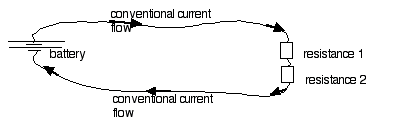
( Notice I have used "conventional current" from positive to negative instead of proper electron flow.)
Two things become clear by thinking about our water circuit and applying it to the electrical circuit.
• The current through both resistors is the same. (Think about electron [raft] loss - there is none.)
• The sum of the voltages across each resistor equals (close enough) the battery voltage. (Think about the total height of the two rapids equalling the ramp height - the height up must equal the height down, the energy given must equal the energy lost.)
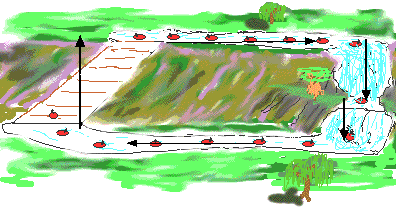
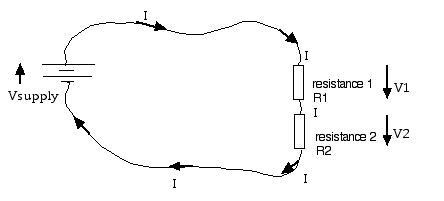
Using these observations, we can find the rule for what effective resistance exists in a circuit if two or more independent resistances exist in series. Common sense almost gives the answer without resort to logic. We would expect the resistances to merely add because one follows the other.
Now, using the above observations
Vtotal = V1 + V2
Vtotal is the same as Vsupply
also V1 = IR1, V2 = IR2 , the formulae giving the meaning of resistance applied to each resistance separately. The current through each is the same.
Substituting, Vtotal = IR1 + IR2 = I(R1+R2) --------- (a)
but Vtotal = I Rtotal , --------- (b)
where Rtotal is the single resistance which has the same effect on the circuit as the separate ones.
Comparing (a) and (b) we can see that
Rtotal =
R1+ R2
eg 1 In a circuit, three resistors are in series. R1 = 500Ω , R2 = 300Ω , R2 = 300Ω, R3 = 400Ω . If the total supply voltage is 12 volts, what voltage will appear across R1, and what current is being supplied?
Solution
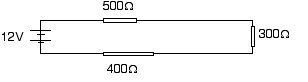
The total resistance of the circuit is the sum
of the three. Knowing the total allows us to evaluate the current flowing.
This in turn will give us the voltage across the 500W.
The total resistance is Rtotal = R1+ R2 + R3
= 500 + 300 + 400 = 1200Ω
So, the current flowing is V = IR
I = V/ R
= 12 / 1200 = 0.01 amps
The current flowing at all points in this simple circuit is 0.01 amps including in the 500W resistance.
Again using V = IR
= 0.01x 500 = 5 volts
We have answered both parts to the question, the voltage across R1 is 5 volts, the current around the circuit is 0.01A or 10mA.
eg2
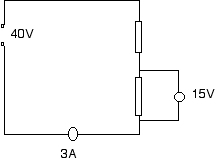
Two resistors are coupled in series to a 40V source. The total current is 3A and the PD across one resistance is 15V.What value resistance do the two resistors have?
Solution.
As the total current is 3A and the PD supplied is 40V, the total resistance is
Rtotal = V/I = 40/3 = 13.3Ω
The resistance of the second component in the diagram can be calculated because the voltmeter gives the PD across it while the current through it is 3A.
R2 = 15/3 = 5Ω
Because the total is 13.3Ω,
the first resistor must be 13.3 - 5 = 8.3Ω
The play backwards and forwards on V = IR under different circumstances is very common. It is a matter of clear thinking of the circumstances under which it applies.
Good notation is crucial to clearly keep track of things.