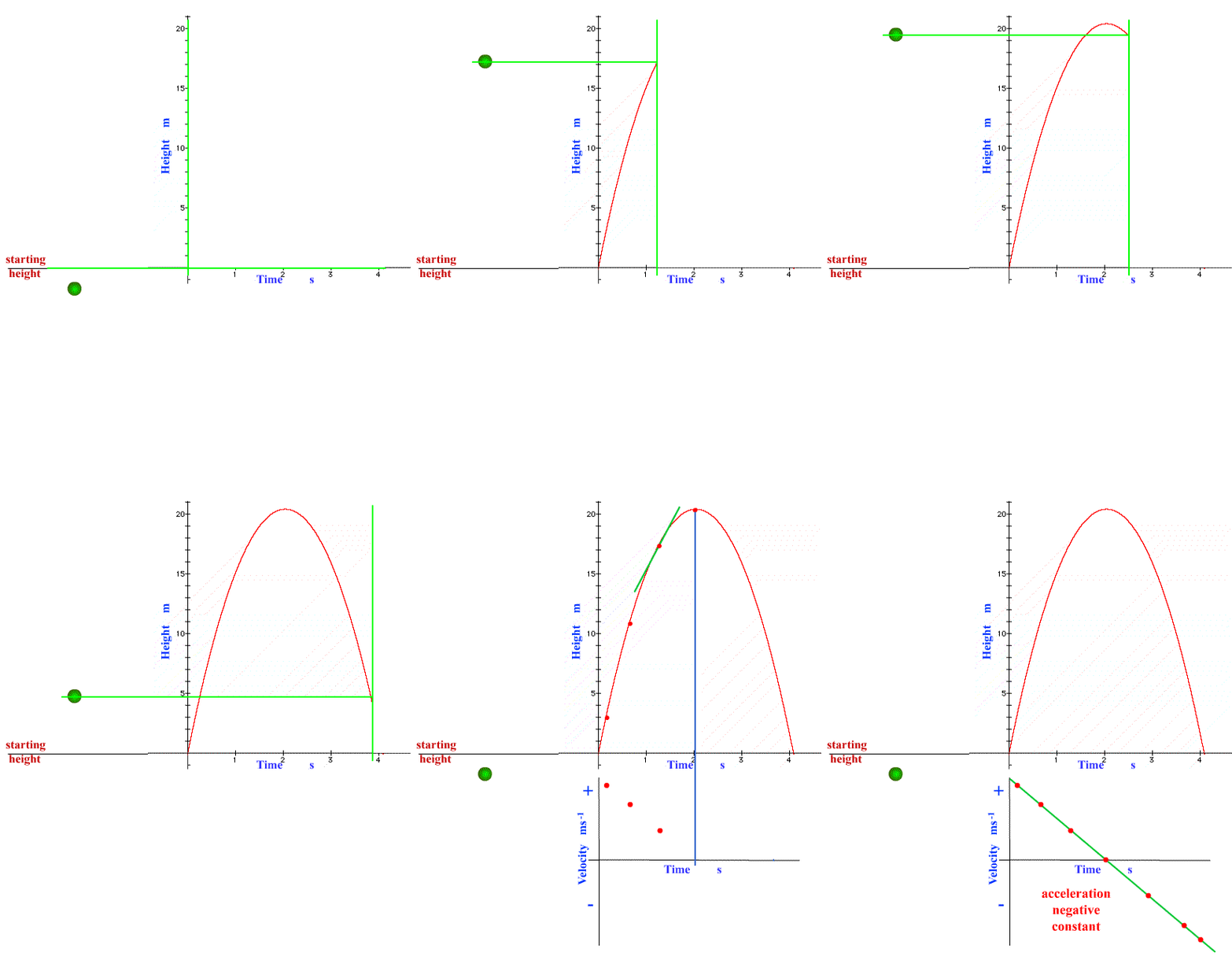
Gravity is an unusual beast that ( ignoring the air resistance ) always causes an acceleration of about 9.8 ms-2 downwards near Earth's surface.
We deal with movement vertically against and with gravity by thinking of a vertical axis of a Cartesian Coordinate system.
The point of departure of the thrown object is the origin. We can chose whether up is positive or negative but having chosen we must stick to the convention throughout the problem.
These notes will use the following for vertical motion.
UP IS POSITIVE
So
displacements above the point of departure are + sign, those below will be - sign.
Velocities upwards will be + sign, downwards - sign.
The acceleration of gravity slows upward (+) velocity but speeds downward (-) velocity so acceleration will always be negative in sign in this convention.
CALCULATIONS
A rock is thrown straight upwards with a starting speed of 30 ms-1 .
a. At what time does it reach its greatest height ?
b. What is its greatest height ?
c. When does it reach a height of 10m ?
Soln;
a. The rock will reach its greatest height
when it stops.
We then have , v0 = +30 ms-1, v = 0, a = - 9.8 ms-2, t = ?
0 = +30 + ( -9.8 ) t
Thus t = 30 / 9.8 = 3.06 s
= +30. 3.06 + 1/2 (-9.8) (3.06)2
= +91.8 - 45.9 = +45.9 m
c. The time when it reaches
10m requires a little thought .
It will reach a vertical displacement of +10m twice,on the way up and on the way down .
Using s = v0t + 1/2.a.t2
again,
we solve a quadratic equation. +10 = +30t - 4.9t2
( In this case it is possibly easiest to use the general
formula; link
to Quadratic Equation Tutorial
if
at2 + bt + c = 0 ,
then t = ( -b ± { b2 - 4ac }1/2)/2a but a second method exists - see bottom! )Manipulating the equation gives
so t = (30 + 5101/2)/9.8 and t = (30 - 5101/2)/9.8
So +10m occurs at , t = 0.755s and 5.36s
Another way of doing this, avoiding the quadratic formula is a two step approach. Calculate the velocities at +10m then calculate the times using 2as = v2 - v02
2 x (+10) x (-9.8) = v2 - 302 gives v = ±
26.5 ms-1
Now use v = v0 + at with both velocities and we get the same times!