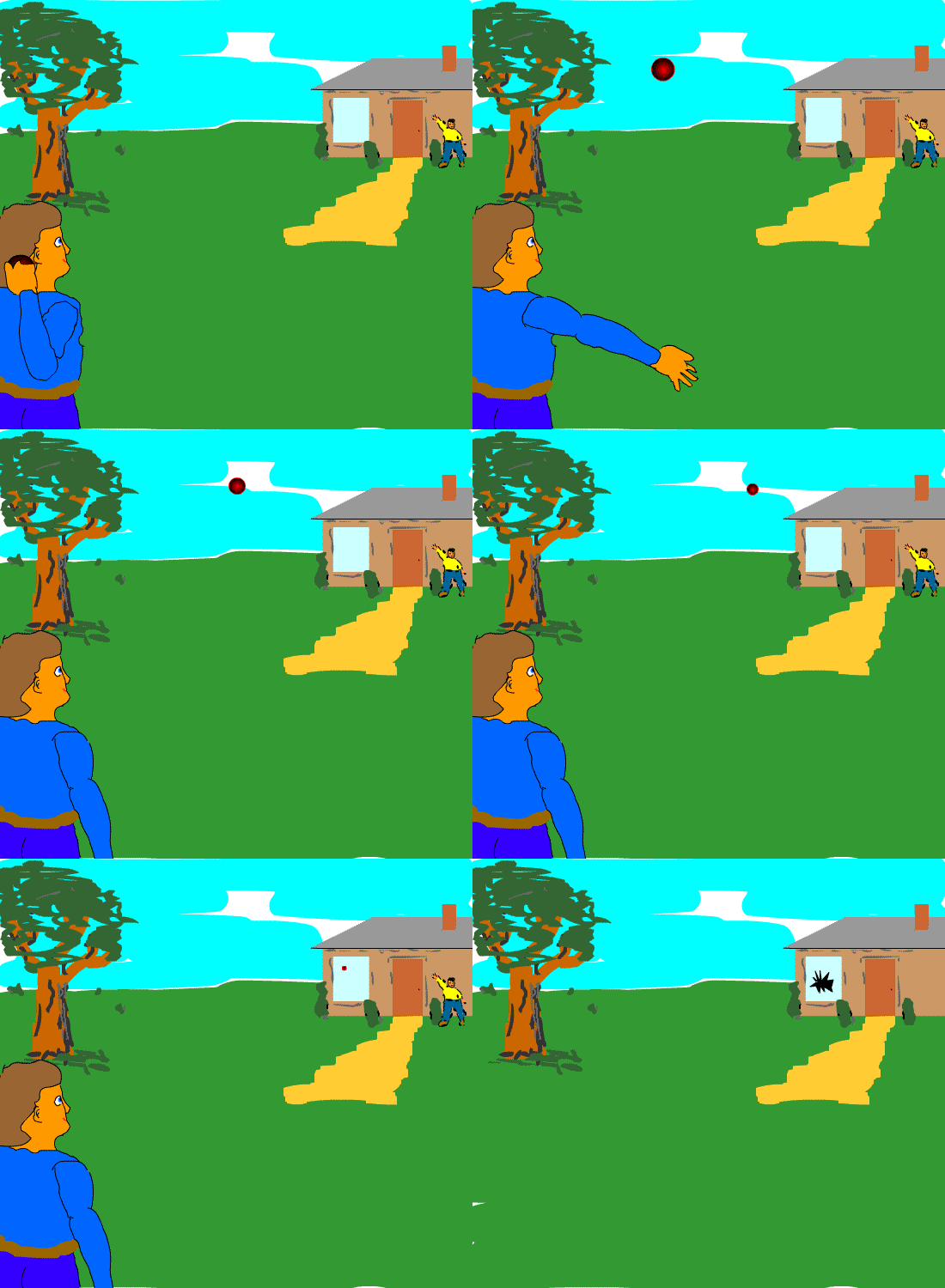
PROJECTILE MOTION -an important 2-dimensional movement.
This is very common movement - every time a ball is hit or thrown through the air. It occurs in a vertically aligned plane ( an up-down plane ) instead of on the flat plane.
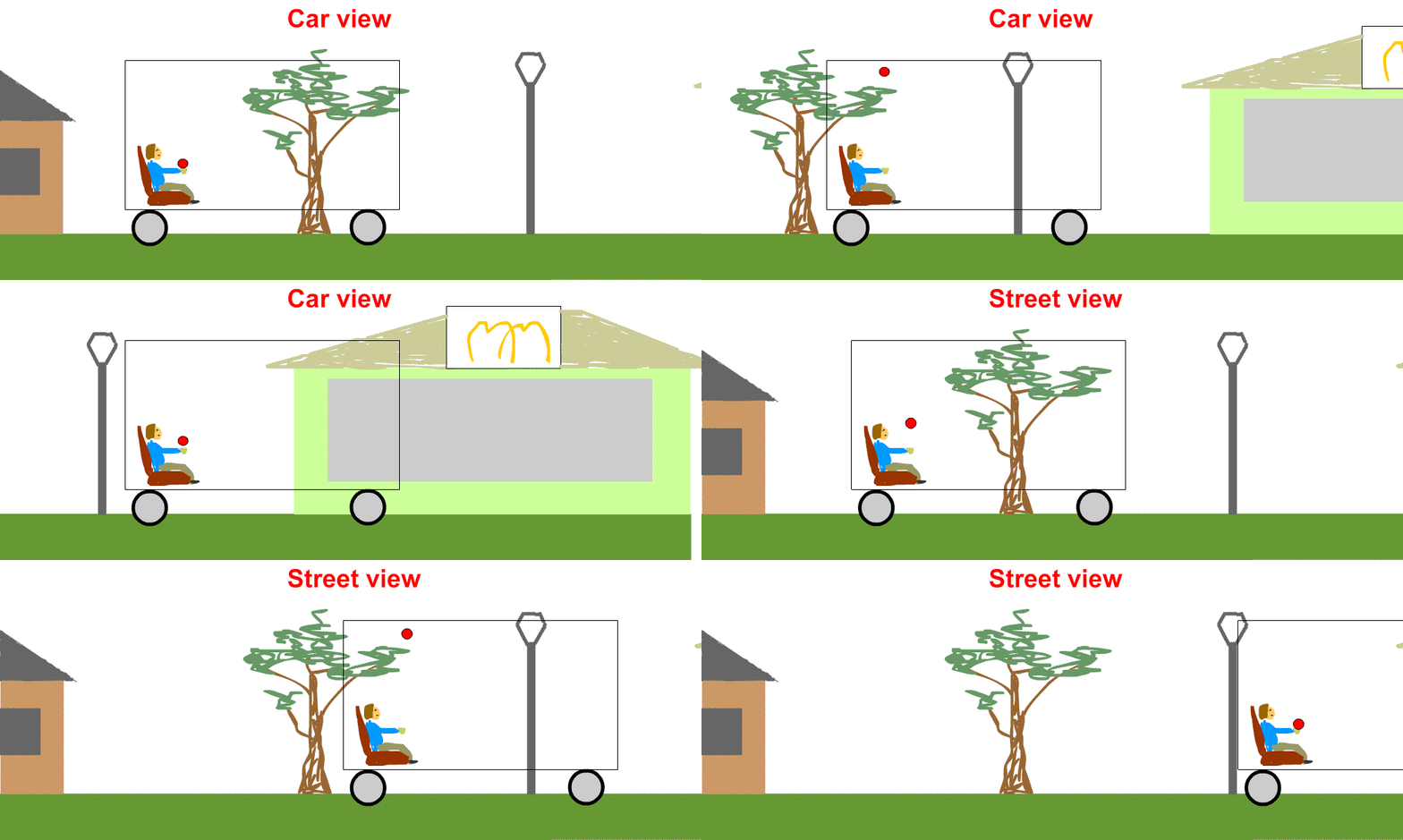
Projectile Motion can be thought of as vertical motion that is changing combined with a forward motion that is not changing. Think of yourself in a car travelling forwards at 100kmh-1. You toss something up and catch it. From your point of view, frame of reference, it is vertical motion but from someone on the foot path, it is projectile motion.
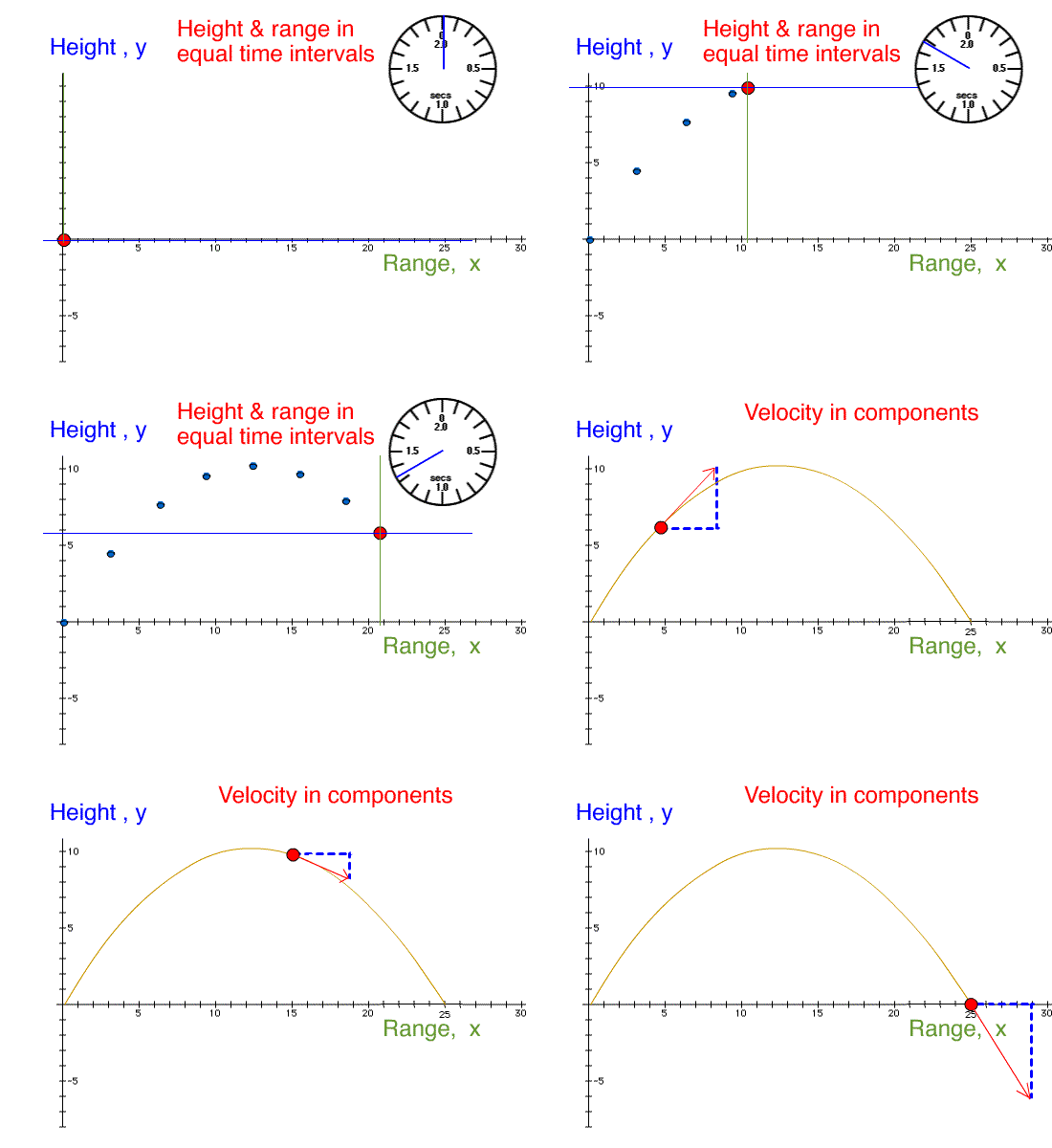
Whenever a stone is thrown, it moves forward and up and down. It does not move sideways ( if we ignore affects due to the air ) so it remains in a vertical plane.
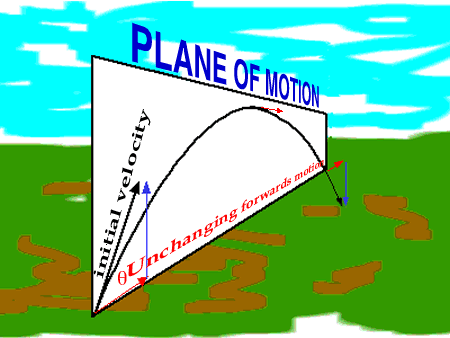
The arrows represent the velocity at three instances; the beginning, the centre and the finish.
Lets look at the velocity at the beginning of its motion - the initial motion.
From sideways on, it is moving at an angle to the flat ground. We can think of this true initial velocity as being made of two velocities just as the ant had two velocities when on the conveyor belt.
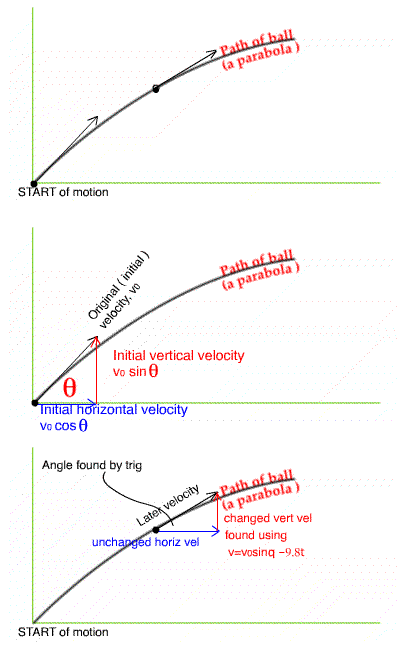
(Notice that the motion of the thrown object curves away below the direction of the initial velocity - the velocity keeps changing direction and size, it is accelerating due to gravity.)
We can split the true initial velocity into the two parts either algebraically or geometrically because we have selected a very simple angle between the parts - 900 ! Whenever we split a vector back into right angled parts we say we are finding the components of the vector.
We use the simple trig functions of sine, cosine and tangent together with Pythagoras' Theorem to find the components of the initial velocity.
Let vo be the true initial velocity
sin θ = upwards
initial velocity, voy
( sin θ
= opp/hyp )
vo
So voy = vo sin θ
cos θ = forwards
initial velocity, vx
( cos θ
= adj/hyp )
vo
So vx = vo cos θ
The value of this is that we can now work out what is happening when something is thrown.
Remember that the acceleration of gravity only acts downwards locally towards the centre of the Earth. That means that the acceleration only affects the vertical component of the motion ! The forward part, vx does not change throughout the flight ( provided we ignore the air ).
The problem of this motion is now no different from vertical motion, but with an unchanging forward motion. It becomes very important not to confuse the different velocities so labelling and layout of solutions is crucial. ( Some 2/3rds of errors in these problems comes from confusing the various velocities. )
When doing these problems, they mostly involve finding the time first from either the vertical or horizontal motion then substituting into the other part.
1. Make lists of vertical and horizontal knowns and unknowns
2. Look at these lists and decide which will give the time
3. Solve for time
4 Use this time in the other list to solve the question
Eg; A shotput is thrown in the Olympics at 25 ms-1 at 600 to the horizontal. It leaves the thrower 1.5m above the ground. How far does it travel horizontally?
Sol; Begin by splitting the initial velocity into components.
= 25 sin 600 = 21.7 ms-1 upwards = + 21.7 ms-1
vx = vo cos θ
= 25 cos 600 = 12.5 ms-1 forwards
Using the upward motion, sy = - 1.5m as its final vertical displacement is downwards ( below the starting point ) . The acceleration, ay = - 9.8ms-2 and voy = +21.7 ms-1.
so 0 = 4.9 t2 - 21.7 t -1.5
thus t = - 0.071 s or + 4.5 s
The forward displacement is then, from s = vot + 1/2.at2 , a = 0 in forwards direction.;
sx = vx t
= 12.5 x 4.5 m = 56.2 m
Link to Quadratic Equation Tutorial
PROBLEMS
1. Alice is into stupidity and thrills. She jumps from Kings Bridge over the Gorge at low tide. The drop is 10m. How long is she in the air for? If she has a forward speed of 6 ms-1, how far forward does she go? ( 1.4 s, 8.4 m )
2. You throw a stone over a 45 m cliff at 20 ms-1directly forwards. How far from the base of the cliff does the stone land? ( 60.6 m )
3. Explain why times actually measured for dropping are longer than simple theory. An extreme to this is a paper dart. Where in the Solar System might theory and practice agree perfectly?
4. A ball is hit at 20 ms-1at an angle of 300 to the ground. What forward and what vertical speeds does this represent? ( 17.3 ms-1 f, 10 ms-1 sv )
5. A TV camera is looking down on a golf ball which has been hit by Jason Day. The ball travels 120m in 3 seconds. What is the ball's forward speed? Is it possible to tell the ball's vertical speed at any instant from the camera shots? (40ms-1)
6. Explain why it is crucially important to think in terms of horizontal and vertical motions.
7. You hit a tennis ball in backyard cricket
at 30 ms-1 at an angle of 600 from
the ground. What are the ball's horizontal and vertical
speeds just after leaving the bat. How long is it in the air for? How far
away does your Father have to be to catch you out? ( 15 ms-1
h,
26 ms-1 v, 5.3s, 79.6 m)
8. On the moon, Astronaut Bloggs, hits a stone at 250 to the ground with a speed of 40 ms-1. Given the acceleration caused by the Moon's mass is 1.6 ms-2, find how far the stone goes on the flat plain on which he has landed. ( 765 m )
9. You are a shotput thrower. Your throwing speed is 15ms-1. During training, you toss two shots, one at 400 and the other at 450. Assuming your shot leaves at ground level - which it doesn't, how much further does the 450 one go? ( It turns out that this is the perfect angle for maximum distance. ) ( 0.3 m )
10. ( This is trickier ). You throw your teddy bear at 10 ms-1 and an angle of 500. How far away is it when it is at a height of 2 m ? ( 2.13 m, 7.9 m )
11. In a dummy spitting competition from a sitting start, who wins, Joanne with a spit of 4ms-1 at an angle of 300 or Peter with a spit of 4.5ms-1 at an angle of 250 ?
( Peter by 16 cm )
Assume gravity near Earth operates with an acceleration
of 9.8 ms-2 .