- movement across flat surfaces
We have looked at simple movement along a straight line for example a road. Many types of movement are done over a flat surface however - turning a corner, sailing an ocean, flying a plane. We need to look at the implications of this.
We keep the same ideas from before; displacement, velocity, acceleration.
These quantities have the sense of direction which is vital when we go off on an open plain. ( Imagine bushwalking with no compass or map - no sense of direction. )
Lets go bushwalking keeping our sense of direction.
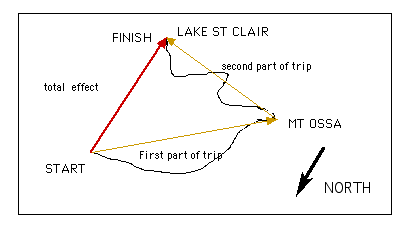
The map shows the start of the trip, the first destination ( Mt Ossa ) and the track to it, and the second destination and its track ( Lake St Clair ). The DISTANCE WALKED will be the total along the tracks, but the DISPLACEMENT on each section is the arrow. The TOTAL DISPLACEMENT is the thick arrow from start to finish. ( Remember that displacement is the straight line from start to finish with direction! )
The map is a scale drawing, and the arrows will be scaled accordingly. The use of arrows in two dimensional motion is a very useful technique.
Do a scale drawing of one arrow followed by another and the subsequent gap is the total!
We call this vector addition.
Average velocity remains total displacement
over time taken and is now an arrow in the same direction as the total
displacement.
Instantaneous velocity is also an arrowed quantity and can be put together by the same process of arrows.
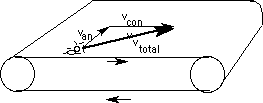
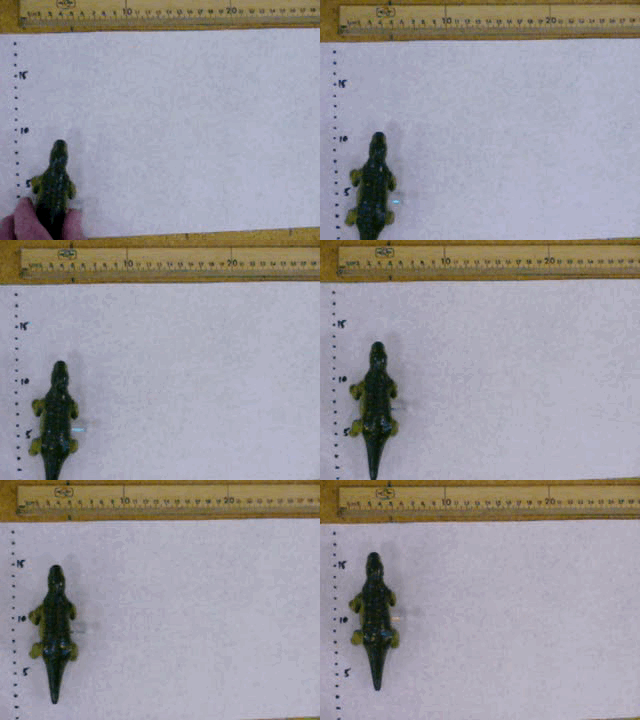
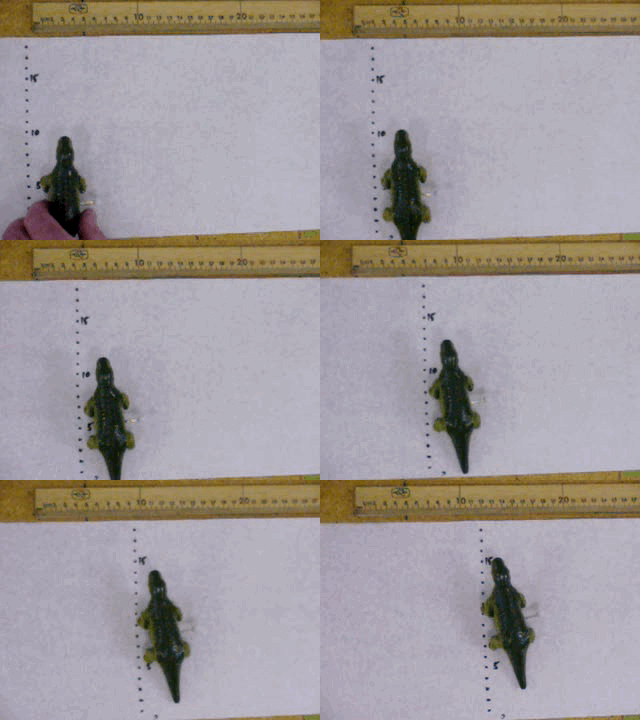
The ant is attempting to cross the conveyor belt. It can run at a speed of 5 cms-1. The conveyor belt travels continuously at 15 cms-1. In one second then, the ant runs 5 cm, the conveyor belt 15 cm.
Point the ant in the direction it is to run at on the belt - this is represented by an arrow in that direction scaled for 5 cm, and join to it the arrow pointing in the direction of the belt scaled for 15 cm. The gap is the total displacement in one second, the total of the two velocities.
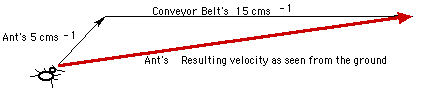
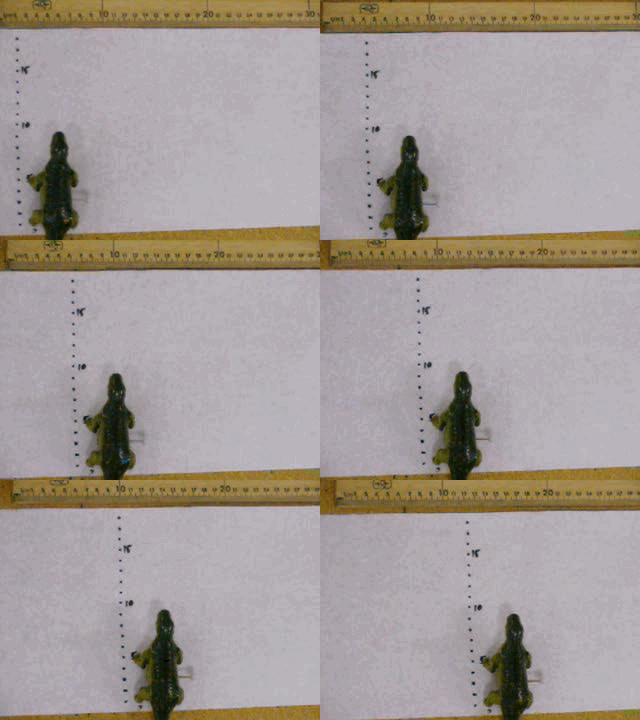
The first picture is of the conveyor belt moving, the second is the toy moving while the third has both moving.
This process is used by aircraft pilots and ships' navigators.
There are many quantities that you will come across that require this sense of scaled drawing to solve.
Quantities that don't need this sense of direction are classified as scalars and include speed, distance and mass.
SUBTRACTING VECTORS
The processes above are called ADDING VECTORS - draw one vector, draw the other on the tail of the first ( the order does not matter ), the gap is the total.
We subtract these arrowed quantities by asking what is the NEGATIVE of the second vector and then adding the negative as above.
The negative of a vector is the same arrow BUT REVERSED in direction !
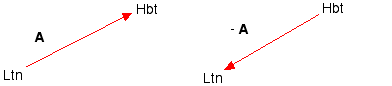
So , to subtract two displacements or velocities , or any two vectors;
a) Draw the first of the two vectors , the one which is to be subtracted from,
b) Reverse the second in direction
c) Add the reversed vector to the first on a
scale drawing
Eg; Subtract the effect of a 5 knot current which is going due North from the observed motion of a ship going at 25 knots West.
Soln; Draw a scaled drawing of 25 knots West

PROBLEMS
1. Walk 25m due North then 15m SE. How far, and in what direction are you from your starting point? ( 17.9m, N36.40E)
2. Why do you think that teachers feel it is important for you to put arrowheads on the pictures of vectors?
3. You are flying a Cessna 172 from Tas Aero Club at 180 kmh-1 pointing 3250 on your compass. The weather forecasts tell you that a 20kmh-1 wind is blowing from the West (2700) .What is your speed and direction over the ground? (169.3 kmh-1, 330.50)
4. You are a runner in the Olympics. To set a world record, the rules allow a maximum tail wind. Why? What do you think applies if it is a cross-wind?
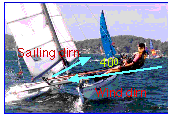 5.
You are sailing a catamaran " upwind " at 20 kmh-1
at a angle of 400
off the direction of
the wind.
5.
You are sailing a catamaran " upwind " at 20 kmh-1
at a angle of 400
off the direction of
the wind.
How long will it take to travel 20km directly into the wind? (Barring accidents)
How fast are you travelling at right angles to the wind? ( 1hr 18mins, 12.9 kmh-1 )
6. Sandra (aged 7 ) has two boyfriends, Tom and Peter ( both 6 ) ( Sandra likes younger boys ). Sandra has a Bear which is very dear to her but is grabbed by both Tom and Peter who each pull with a force of 30N at an angle of 600 to each other.
Sandra pulls in the opposite direction to both of them and exactly counters their tugs. Before Bear disintegrates, how much is Sandra pulling and in what direction? (Hint - Sandra's tug must exactly be equal to the combined tugs of Tom and Peter but in the negative direction to them.)
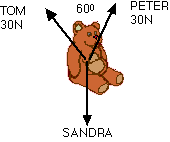
( 52N, 1500 to
both Tom & Peter )
7. You are walking across a moving conveyor belt at right angles to its edge at your usual speed of 1ms-1 . You find yourself moving towards a point angled at 250 to the way you are facing on your right . Try to work out the speed of the conveyor belt! ( 0.466 ms-1 right)
8. (This one is straight forward). Add 16m North
and 24m E300S and 33m S400E.
(47.1m, S63.10 E)