More on vectorsAll physical quantities we class as vectors are derived from DISPLACEMENTso obey exactly the same rules for "adding" and "subtracting" as displacement- that is geometry.
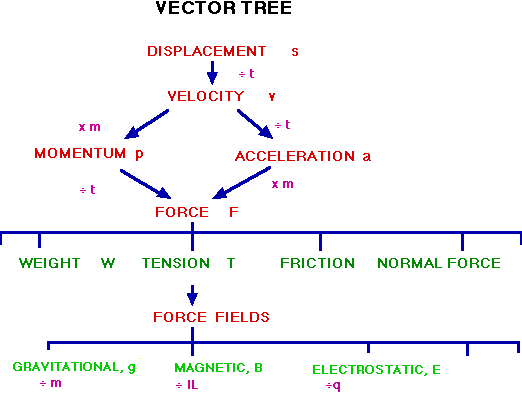
Notice that we multiply or divide by directionless quantities ( scalars) which merely change the size of the original arrow but not thedirection - ie the scale of the arrow.
Different methods of adding vectors
There are many ways of doing the geometry of adding vectors. In theend they give the same answers ( for most people ! ) so are entirely equivalent.Simply adopt the way with which you are most comfortable.
- SCALE DRAWING ( "Heads to Tails" )
This method has results as good as your drawings. The larger the scaledrawing the better. It is the method used in traditional navigation whetherby sailors, pilots or bushwalkers.You need a fine pencil, ruler, eraser for your errors, protractor androom for your drawing.
Technique
- Decide your scale by looking at the sizes of your vector quantities. Typicalscales may be 1 cm = 1 unit or 10 cm = 1 unit.
- Decide the order you wish to add the vectors and draw the first as accuratelyas possible. Put an arrowhead on the end so you ( and everyone else ) knowswhich way you are going. If you have directions relative to a compass,draw North-South East-West lines.
- Measure your angle to the next direction from the end of the first vector.( If necessary you may have to redraw the N,S,E,W lines at the end of thefirst vector.) Draw the second vector. Put an arrowhead on the end.
- Now draw the total by going from the start to the end of the second vector.We often put a double arrow in the centre of the total to make it clearlydifferent. Measure the length and the angles ( eg from the N,S,E,W directionsor the first vector).
- Scale appropriately and quote the answer.
If you have many vectors, keep tacking them on to the end of each other.The sum still goes from the start to finish.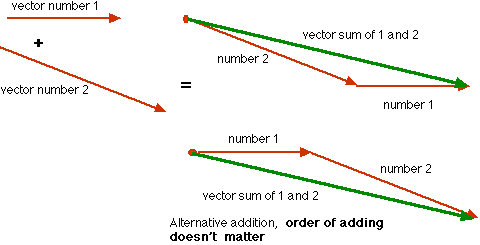
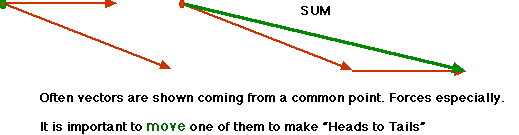
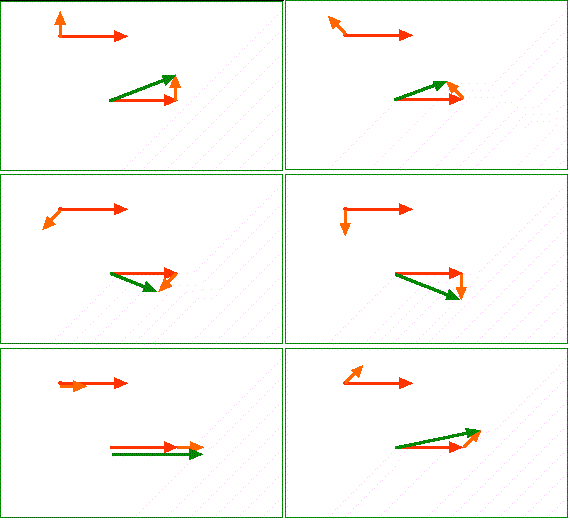
When scale drawings are not accurate enough, it willbe necessary to use the algebraic rules for triangles.METHOD 1 Using COSINE and SINE RULES for triangles
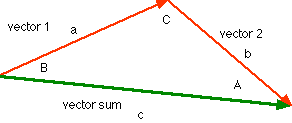
In the above vector triangle, angles and sides are labeled accordingto usual ways - just spot the lower case letters to any old side but usecapitals for the angles opposite the sides.
COS RULE No matter what the sides are
a2 = b2 + c2- 2bc cos A or b2 = a2 + c2 - 2 ac cos B or c2 = a2 + b2- 2abcos C
SIN RULE
a/ sin A = b/ sinB = c/ sin C
Technique
- Do a rough drawing of the vector sum - don't be tooprecise
- Label the sides of the resulting triangle with knownand unknown parts
- Normally use cos rule first to find the missing sidelength
- Use sin rule to find the missing angle to give direction.
- Check that the answer makes sense with respect toyour rough drawing.
Sometimes you may have to use sin rule first thencos rule.
BEWARE:- sin ( 180 - angle ) = sin angle - canmuck you up
- moving a vector to make the triangle plays havocwith angles! The angle between vectors will change to ( 180 - angle) when a vector is slid to addition position.
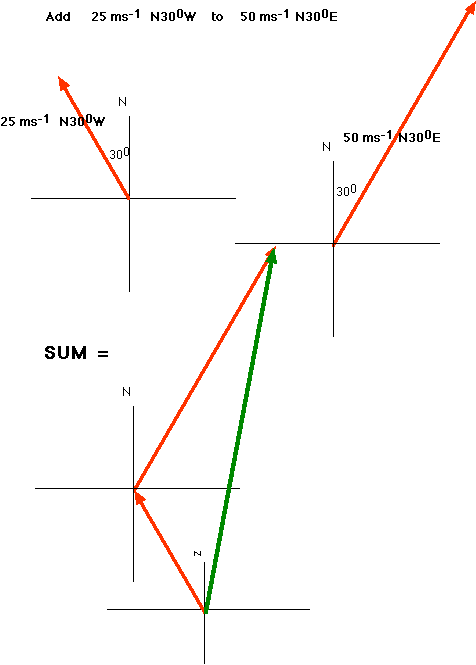
ExampleIf we add the two vectors above namely 25 ms-1N300W to 50 ms-1 N300E then from the diagramof the heads to tails, the angle opposite the sum = 1200 ( not600! ) so the SIZE of the sum using cos rule
a2 = b2 + c2- 2bc cos A
= 252 + 502- 2x25x50xcos1200 = 625 + 2500 + 2500x0.5 = 4375 thus a = sum = 66.1ms-1
Angle using sin rule
a/ sin A = b/ sinB , 66.1 / sin1200 = 50/ sin B thus sin B = 50 sin 1200/ 66.1 = 0.6551
B = 40.90
The vector sum is 66.1ms-1 with an angle of N(40.9 - 30)0E ie N10.9 0E
METHOD 2 USING COMPONENTS
This is used when many vectors are being manipulated. It is not efficient for two vectors but great for multiple sytems and advancedwork.
Link to Components
Return to Phys tutes list