HOUSEHOLD CIRCUITS
In your house, the more things that are turned on, the more current is requested at 240V. Thus the meter in the meter box ticks over quicker and it costs your parents more money.
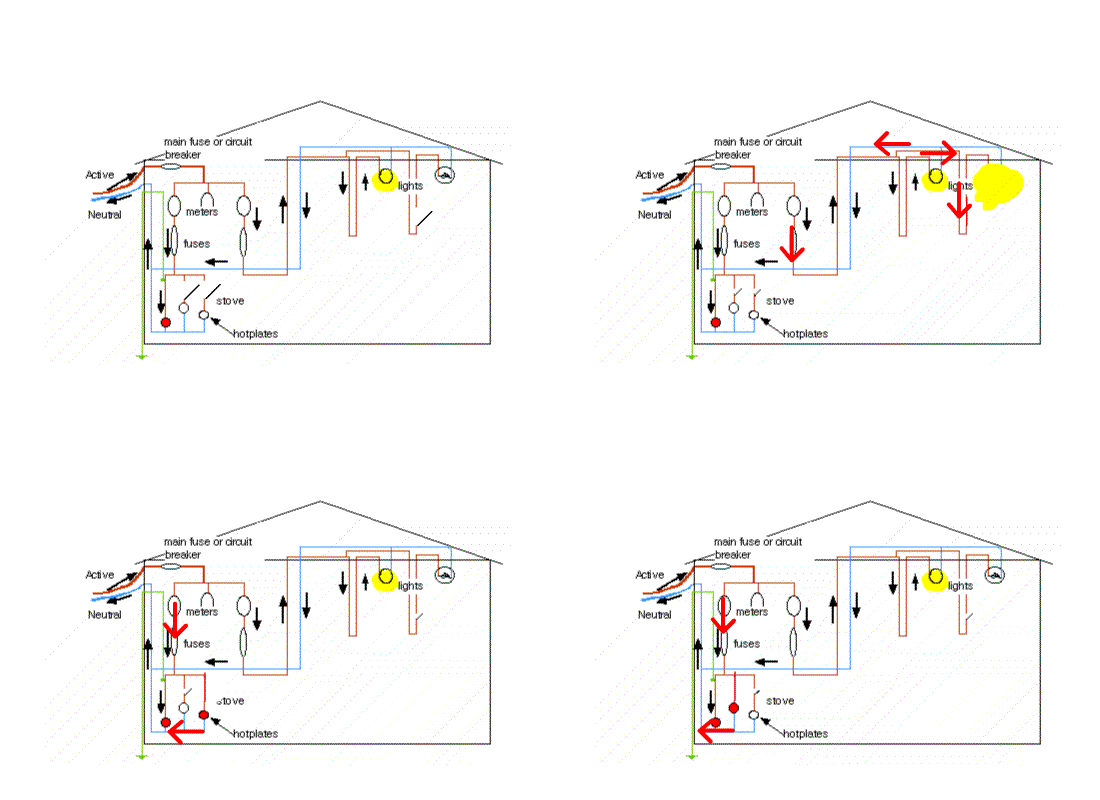
In the above, not very good, outline of a house, two mains leads come into the meter box through a main fuse or circuitbreaker.
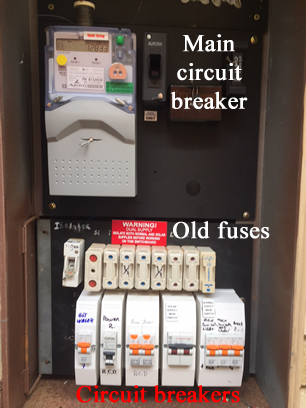
In the meter box, the incoming lead called ACTIVE, a brown (or red in old houses) wire, is split into parallel systems each passing through a meter, a fuse or circuit breaker, then out into the house.
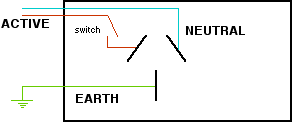
In the house, the active wire is split further into parallel circuits, passed through a switch and then into the hotplate, light or whatever.
After the appliance or load, the wire is called the NEUTRAL or RETURN line which is coded blue (or black in old houses). These are combined and taken back out of the house to the main transformer on a pole.
The reason for the unusual names, active and neutral, is the energy level of the lines.
Compared to the surrounding earth and things in contact with earth, eg you, the active line is at high energy, 240V, while the neutral line should be at 0V.
The active line current is potentially lethal from your point of view but, after passing through the resistance (load), the current is at zero energy with respect to earth, it has lost its energy in the resistance.
Switches are always placed in the active line even though they would work in the neutral line. Why?
The Earth line
An additional line is used in houses, the earthline, a green coated wire (with a yellow stripe), which is supposed to be a safety wire.
This wire runs to a copper rod deeply inserted into the soil outside your house. It connects to the frame of your appliance through the plugs and sockets. If the active wire comes loose and touches the metal frame then the current will go directly into the earth instead of through you to earth.
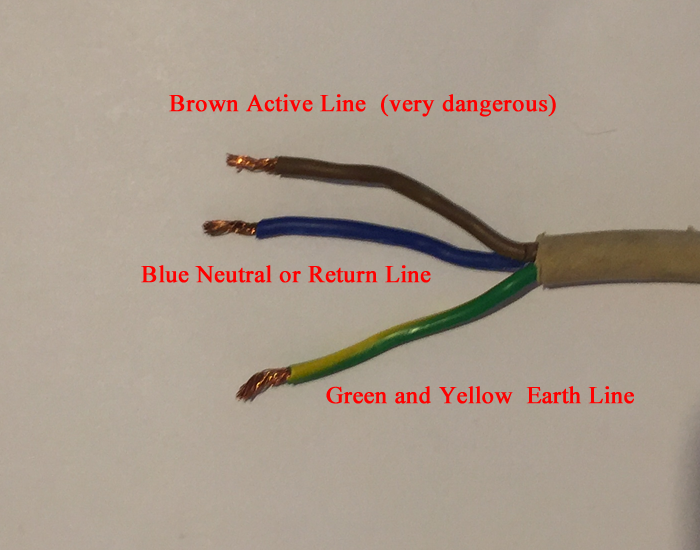
active - brown
neutral - blue
earth - green / yellow
Many plastic electrical goods only have the active and neutral wires because plastic is an excellent insulator protecting the user from faults with the active wire.
The lines MUST be separated from the outside by at least two layers of insulation. This is called DOUBLE INSULATED.
The two layers are the insulation surrounding the active and neutral line and the plastic casing of the product. The power line is always led around a track then clamped across the wire insulation by a screwed down piece of plastic or similar insulator before the lines are stripped to the copper and connected to the circuitry.
If the power cord is pulled, it will not break from the circuit inside or pull out of the product.
Different countries have different arrangements of pins to Australia and they may operate at only 100 to 120V. If you are travelling overseas, ensure the electrical devices you take are compatible with the supply of the countries where you are going!