Photodiodes & Solar Cells
| Photodiodes and solar cells work in the reverse sense to LEDs. If a photon of sufficient energy strikes the valence band in the transition region ( also known as the diffusion region ) of the diode, an electron can be promoted to the conduction band by the photoelectric effect leaving a hole in the valence band. The internal electric field ensures these separate and are available to an external circuit. | |
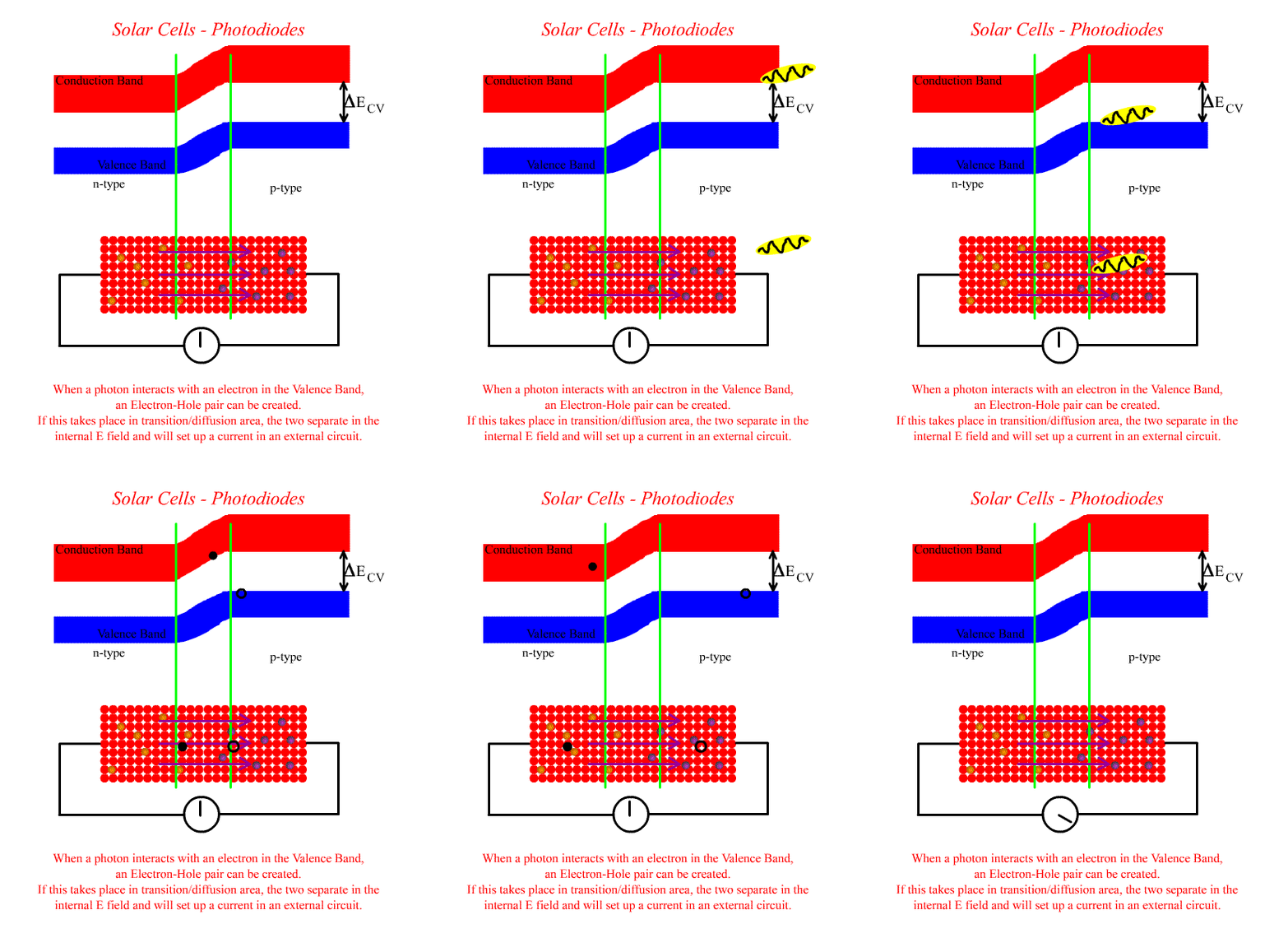
Silicon semiconductor is very good for this purpose with a gap of about 1eV between bands. Thus most light in the visible region and near infrared can create the pairs.
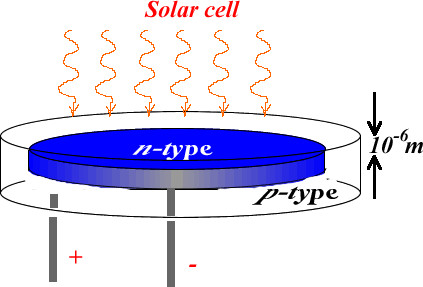
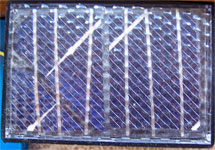
The design of a solar cell is such as to maximise the area of electron-hole creation so the boundary is parallel to the device rather than perpendicular as in an ordinary diode. The p-type is usually a very thin layer ( ~ 1μm ) over the top of a bulk of n-type. This is is to allow as much light to reach the transition layer as possible. Metal grids are inserted to carry away the photo-generated electrons to the external circuit. They may also have aluminium reflectors placed on the back to so any transmitted light may on reflection, create an electron-hole pair.
Unlike a photodiode, solar cells are large area devices to capture as much light as possible, hence produce as much current as possible.
Very recent solar cells use amorphous silicon rather than single crystal, and use grooves to capture light and maximise the area. The very best are about 20% efficient.
Photodiodes are often biased with an external voltage and may have an additional internal layer called the i-layer of little doping inserted into the transition region to enlarge it.