topics photonics index
Light Emitting Diode Laser Diode
Almost all LEDs are made of gallium with arsenic, nitrogen and phosphorus additives.
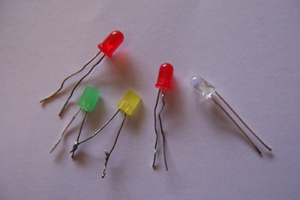
A light emitting diode is a standard diode made of semiconductors of the Direct Band-Gap type of material with its junction physically arranged so it freely emits its photons in the desired direction. The diode is encased in transparent coloured or clear plastic often rounded so as to act as a lens. ( ref )
In direct band-gap materials, electrons do not change momentum when moving from conduction band to valence band so no momentum is transferred to the surrounding structure. Heat is not generated but light is. |
 |
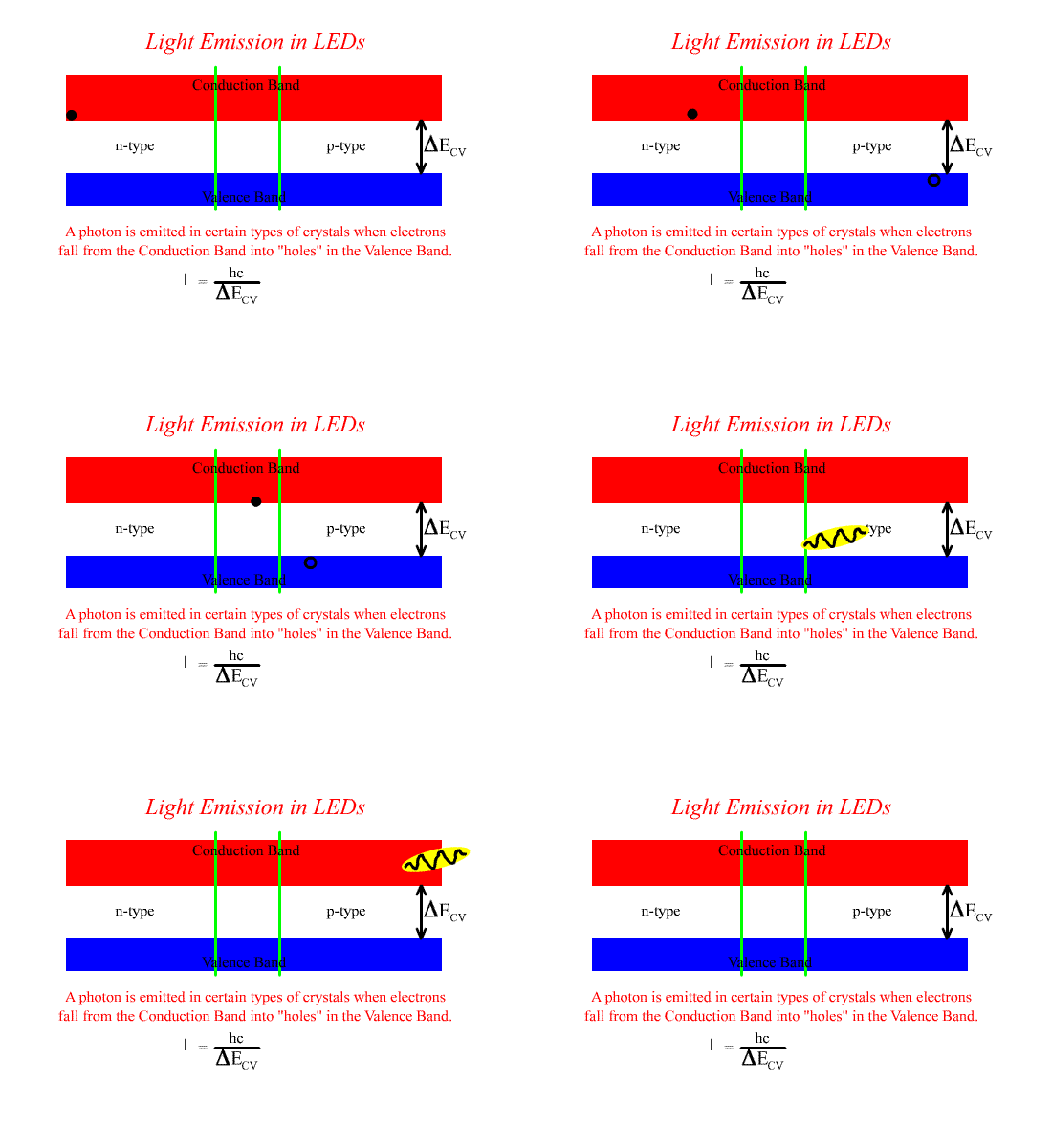
As a DBG diode conducts in the forward direction, electrons fall from the Conduction Band to the lower energy Valence Band. From basic quantum considerations of atoms, electrons falling inwards under the influence of the Electric Field of the nucleus must emit photons with an energy equal to the difference in energy of the two bands.
ΔECV= hf
Because red light is of lower photonic energy, these were the first to be created as the technology was simplest. Blue LEDs are relatively recent devices ( ref ) using Gallium Nitride as the basic semiconductor as it has the appropriate gap between bands ( band gap ).
From the above equation, red has ΔECV~ 2.0 eV whereas for blue light ΔECV~ 4.0 eV.
Ironically, white LEDs currently are blue/UV LEDs with fluorescent impurities in the casing plastic similar to those used in domestic fluorescent lights. The deep blue/UV components are absorbed by the fluorescents and reemitted across the whole spectrum. This is because the current generation of green LEDs are very inefficient and produce too much heat compared to light.
Laser diodes
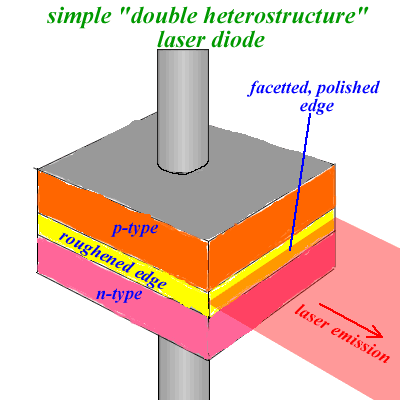
A light emitting type of diode can be made into a laser IF the transition region can be physically "tuned" to the emission frequency by polishing the ends of the emitting region and creating an amplifying region. As with a gas or solid laser, a region which is a whole number of wavelengths is needed with reflection properties at the ends.
The simplest laser diodes are edge gap types where the transition region between the n-type and p-types are carefully facetted - cut cleanly to provide a polished surface- at the appropriate external ends, and roughened on the other ends to discourage resonances. These would lead to spurious laser wavelengths and waste energy.
More complex designs exist with centre laser areas and multiple resonance regions, Fabry-Perot etalons.