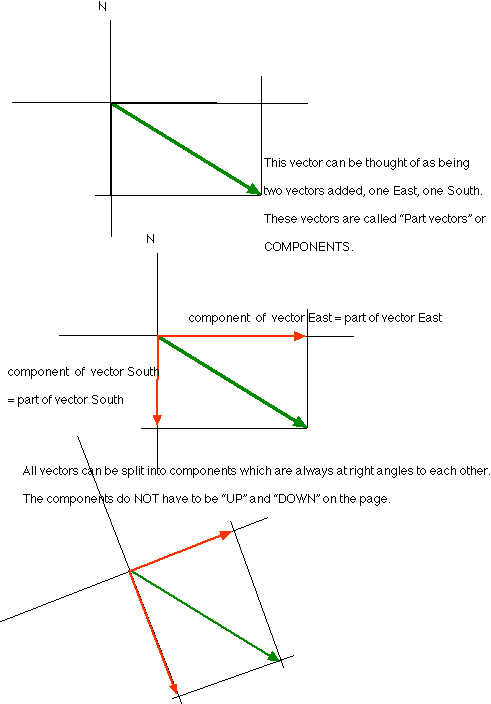
Just as two vectors add to make one, one vector may be broken back totwo ( or more vectors ).
When these are at right angles to each other, they are called COMPONENTS.
They are VERY valuable as they provide important visualisations. A tackingyacht's motion can be thought of as two components - INTO the wind and ACROSS the wind. The motion of a thrown ball at any instant canbe visualised as UP/DOWN and FORWARDS.
COMPONENTS MEASURE THE EFFECT OF A VECTOR INANOTHER DIRECTION
We split the vector by deciding which pair of right angled directionswe wish to use - for convenience - to solve the physical problem - and then use simple trig functions
sin = opp / hyp, cos = adj/ hyp, tan = opp / adj, and Pythag Thm
to calculate the sizes of the components.
ADDING using components
We will add the same two vectors as in the earlierexample, 25ms-1 N 300 W to 50ms-1N 300 E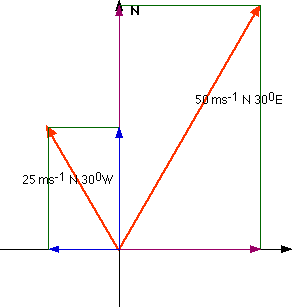
Vector 1 = 25ms-1 N 300W can be considered as two components, 25cos 300N and 25 sin 300 W both in ms-1
Vector 2 = 50ms-1 N 300E can be considered as two components, 50cos300 N and 50 sin 300 E both inms-1
Vector 1 = 21.65 ms-1 N and 12.5 ms-1 W
Vector 2 = 43.3 ms-1 N and 25 ms-1 E
The sum is therefore (21.65+ 43.3)ms-1 N and (25 - 12.5)ms-1 E ie 64.95 ms-1 N and 12.5 ms-1E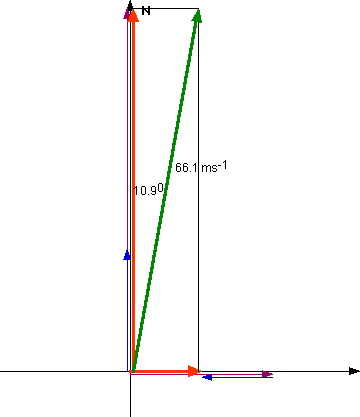
We then put these back together with Pythag theoremand simple trig
Sum = sq root ( 64.952 + 12.52) = 66.1ms-1 and tan angle = 12.5 /64.95 = 0.192 thus is N 10.90 E
This is the same answer as before.
Vector subtraction is equally easy - simply subtractinstead of add.