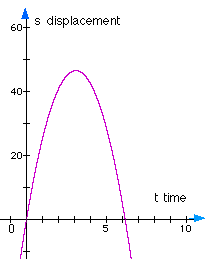
In physics, mathematics is used continuously. As the maths gets more tricky, it seems to lose familiarity and maths classes seem to have nothing to do with the maths in physics.
Maths classes seem only to use "x, y, z" whereas physics seems to use "s, v, t, a" and other unfamiliar letters which are confusing.
Basics - A QUADRATIC FUNCTION = anything like
y = 3x2 - 2x + 3 or y = 3 - 2x +3x2
or y = -3.42q2 + 1.003q
or s = 30.2t - 4.9t2
(NOTICE that the ORDER of writing terms in equations is unimportant, we often forget this, we tend to think that to be a quadratic equation it has to look like y = 3x2 - 2x + 3.)
GRAPHING A QUADRATIC FUNCTION
Lets work with the quadratic function
s = 30.2t - 4.9t2
In maths, this is a formula ( a "function" ) which you might be expected to graph.
You would
Applying this to the equation, either 0 = 0 x ( 30.2 - 4.9t ) or 0 =t x 0
That is either t = 0 or ( 30.2 - 4.9t ) = 0
If 30.2- 4.9t = 0 it means that
30.2 = 4.9t ( remember switching addition to the otherside changes signs )
so 30.2/4.9 = t ( remember switching multiplication turns to dividing )
giving this answer as t = 6.16.
Two answers for zeroes t = 0 and t = 6.16
In physics, this function models a vertically moving ball which started moving at 30.2 ms-1 upwards and is accelerating downat 9.8 ms-2. "s" is its vertical displacement ( read "height") and "t" is the time in the air after starting.
We can use both the graph and the function to calculate useful details.
If we know a value of "t" we can substitute in the function ( or drawon the graph a line ) to find "s". That is - knowing time, we can calculate height.
However, if I know height "s", I can, with a little more difficulty, calculate time, either graphically or through the algebra of quadratic equations.
Why more difficulty?
Look at the example below where I graphically wish to find the times when the height is 20m above the start ( +20). I get two times, one when going up, the other when coming down.
Now, how do we do this algebraically.
We take the function, s = 30.2t - 4.9t2
And we say, "s = height takes the value, +20" that is
+20 = 30.2t - 4.9t2 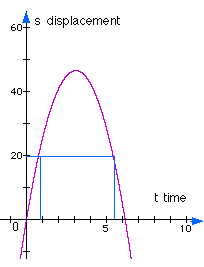
that is
+4.9t2 - 30.2t +20 = 0 ( remember rules for moving across equals signs )
To solve this little equation - we need either to factorise ( unlikely to happen easily here) or to do some fancy work witha rote formula.
Solving +4.9t2 - 30.2t +20 = 0 for t.
Simple versions of these are solved by factorizing, but complicated versions don’t easily factorize. We need to use a "formula" approach. In maths one is developed by playing at algebra.
Maths teachers start with the most "general" version of the equation that is possible.
" ax2 + bx +c = 0" ( numbers a, b,c are called coefficients.)
They then show that x will always be calculated by the formula
x = ( -b ± {b2 - 4ac}1/2) / 2a remember the index "1/2" means sq root !
In the above case a = +4.9, b = - 30.2, c = +20 so
t = ( - -30.2 ± {[-30.2]2 - 4x4.9x20}1/2)/ 2x4.9
= (30.2 ± {912 - 392}1/2 ) / 9.8 = (30.2 ±520 1/2) / 9.8 = ( 30.2 ± 22.63) / 9.8
giving two answers which can be seen on the graph above
t = 5.39 seconds and 0.77 seconds.
The 0.77s corresponds to going through +20m on the way up
while the 5.39s corresponds to +20 m on the way down.
This is clear from the graph above.
Exercise
Calculate the times for the function s =30.2t - 4.9t2 when s = +10m and when s = - 10m . See if these agree with the graph.
Sometimes the answers will not make sense meaning that no realanswers exist. An example would occur for our s = 30.2t - 4.9t2ifs = + 60m. The algebra would give you ridiculous square root answers. Physically it means that the ball does not reach +60m. (Check both by calculating using the formula and by looking at the graph).
At present in physics you will not meet these cases.
Not all answers have physical meanings. Negative time answersare simply artificial artifacts of using algebra and not looking at thephysical situation.