Mass
is a quantity which is a little elusive, the more we think we know what
mass is, the less we really do! No physicist in the world really understands
it but we do have a fairly good idea of what it does.
In 2012, the operators of the accelerator on the Swiss-French border at CERN announced that they had probably discovered a sub-atomic particle or field called a Higg's Boson that produces some of the properties of mass for atoms.
The effect of mass on motion is important. Imagine two objects moving towards you, a tennis ball at 2 ms-1 and a car at the same speed. Your impression of danger is implicitly linked to your estimation of both speed AND mass. The ball is clearly less dangerous.
The person who saw this and incorporated mass into his dynamics for the first time ever was Isaac Newton.
We shall start by looking at mass
and velocity combined.
Imagine the process of catching a ball thrown at you by your "best" friend. The ball hurtles into your hand and your hand moves back as a result. Your hand acquires some of the motion of the ball. The effect is changed by both the velocity of the ball and the mass of the ball.
We can think of plenty of cases where motion
is transferred and even cases where motion disappears! The head on collision
of two netball or football players are cases in point . There are, of course,
situations where motion appears from no motion - an exploding handgrenade
or when two people push away from each other !
We make a new quantity to describe the combined velocity - mass effect.
MOMENTUM ( p ) - is the product of the mass and the velocity of a body.
The crucial thing about momentum is that it obeys
a "conservation" rule !
Conservation rules are extremely important because they say something about the nature of our Universe. ( What, we are not entirely certain about. )
A Conservation rule allow us to calculate a quantity
which does not alter thereafter and enables us to predict outcomes as a
result.
THE PRINCIPLE OF CONSERVATION OF MOMENTUM
" In a closed system the total momentum remains at all times constant."
A closed system is one in which we can account
for everything.
Eg;
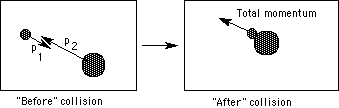
The boxes above represent a "closed system". There are only two bodies in it and we can account for their individual momentum exactly.
Something happens in the system, the two objects combine for some reason ( which we are not particularly interested in at the moment ).
In the example above; Let the direction of p1 be positive, then p2 is negative.
Total momentum p = + p1 + ( - p2 )
= momentum of combined masses by Conservation of Momentum.
Suppose now the balls separate, they have bounced apart;
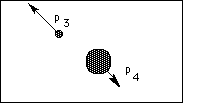
each has a new momentum, p3 and p4.
Then; Total momentum p = ( - p3 ) + p4 = + p1 + ( - p2 )
by Conservation of Momentum.
"p" is fixed throughout all possible interactions in the box !
( Note; Some teachers use arrows in brackets behind the value of the momentum instead of, or as well as, +,- . Fine ! This reinforces a sense of direction which is useful at a more advanced level. )
Notice the use of "BEFORE"
and "AFTER" continuously in solving these situations - BEFORE the
explosion ( or whatever ) and AFTER the explosion
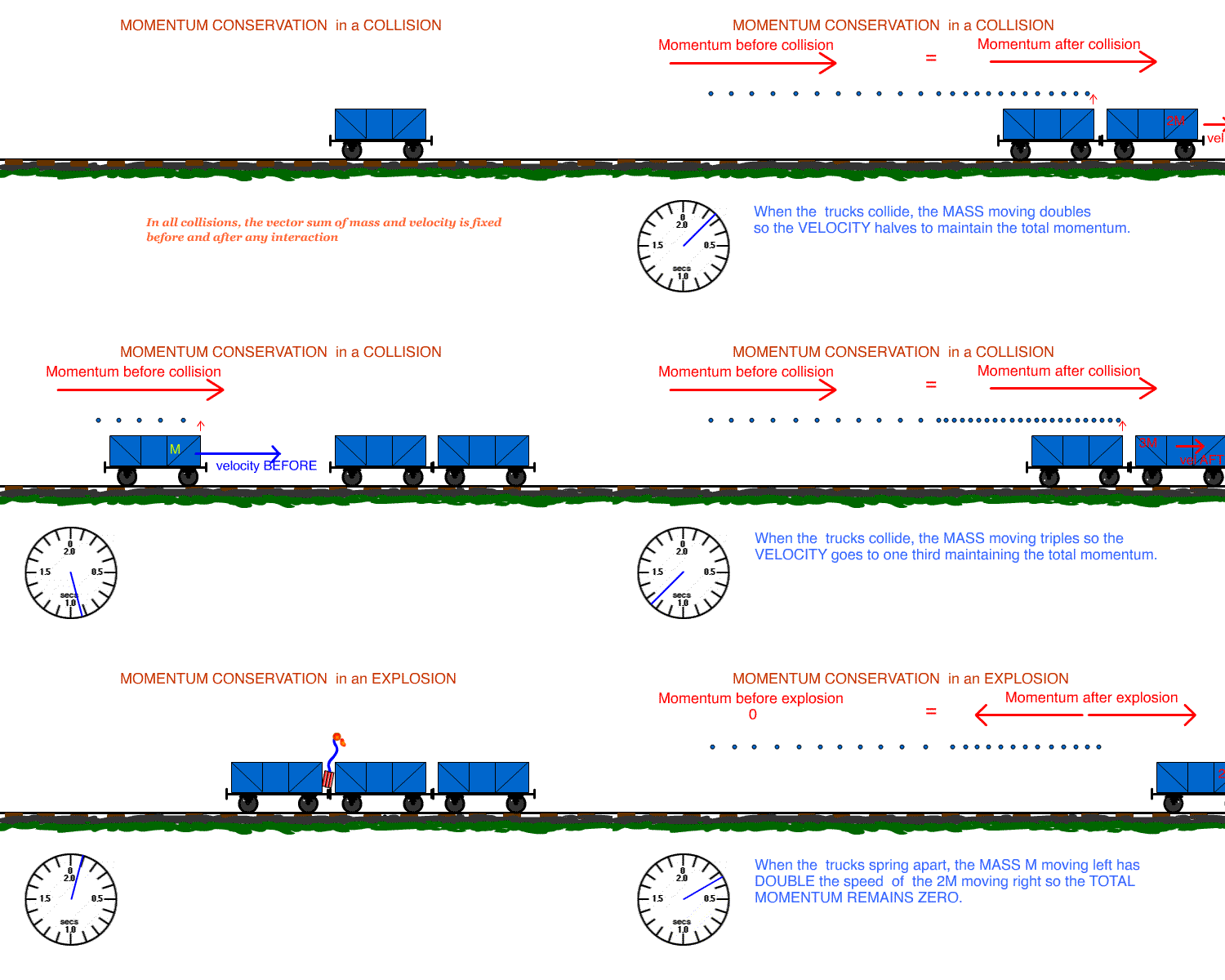
Numerical examples of Conservation of Momentum in use.
Eg 1; A girl is to fire a shotgun mounted on a trolley to measure the speed of the shot. The gun and trolley has a mass of 5 kg while the bird shot has a combined mass of 100 gram ( = 0.1 kg ).
After firing, the gun and trolley recoils at
8 ms-1. What is the speed of the bird shot on leaving the barrel
?
Soln;
Before the
explosion
the total momentum of the gun and shot = 0 (
not moving )
After the explosion
the total momentum of the gun and shot = mgun.vgun (left ) + mshot.vshot ( right)
= 5( - 8 ) + 0.1 . vshot
By Cons. of Mom. , Initial momentum = Final Momentum
thus 0 = -40 + 0.1 .vshot
so vshot = +400 ms-1
Eg 2; Ted, 45kg, running to the right at 8 ms-1, in a friendly SRC game of touch football, collides front on with Alice, 65 kg, running to the left at 9 ms-1. During the collision, Alice gives Ted a little shove so Ted finds himself moving to the left at 5 ms-1 immediately after. At what velocity does Alice find herself moving after this minor fracas?
Soln;
Before collision
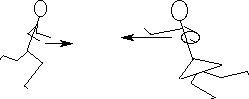
= 45 .( +8) + 65 . ( -9 ) kgms-1
= 360 - 585 kgms-1
= -225 kgms-1
The total momentum is to the left , and has size 225 kgms-1
After the collision
= 45. ( - 5 ) + 65 vA
= - 225 + 65 vA
But , Initial Mom. = Final Mom. ( Cons. of Mom. )
Thus -225 = - 225 + 65 vA
So 0 = 65 vA , thus vA = 0
Alice is stopped by the collision.
The rule of Momentum Conservation works in all dimensions and under every circumstance where we can account for every item.
It is used to deduce the masses of subatomic particles like Zo particles in supercolliders, and is used in Astronomy. It tells us nothing about collisions or explosions as such, but a great deal about the rules of the Universe.
Link to Forces Two Dimensional Momentum Conservation
Return to Year 11 Phys tutes list
PROBLEMS
1. Your "new" car, a Datsun 180B, has a mass of 900kg including you and your friends. What momentum has it when travelling at 60km/h due North? ( 1.5 x 10⁴ kg ms-1 N )
2. Taking your car as above, and another car coming South, find the total momentum if the other car is a Commodore of mass 1300kg travelling at 70km/h.
You then have a head-on collision ( not pleasant ) - what is the total momentum immediately after the collision? ( 1.03 x 10⁴ kg ms-1S )
When the wreckage has stopped moving, where has this momentum gone?
3. You are standing on a skateboard and attempt to step off forwards. Explain the skateboard shooting off backwards in terms of momentum conservation.
4. In a game of squash, Jim and Alice collide,
Jim is moving at 2ms-1 to his left with
a mass of 55kg, Alice to her right at 1.5ms-1with
a mass of 60kg. The two entangle. What is the total momentum of the pair?
With what velocity sideways does the two entangled people fall to the ground?
(20 kgms-1 left, 0.17ms-1 left
)
5. In question 3, your mass is 40kg while the skateboard has a mass of 1kg. If you manage to get a velocity of 0.05ms-1, what velocity is given to the skateboard? ( 2ms-1)
6. A trolley ( 10kg ) is rolling along at 5ms-1and has a 5kg mass dumped straight down on it. The trolley promptly slows. What to? ( 3.3 ms-1)
7. A cricket ball, mass 0.14kg is hurtling down towards you at 30ms-1 . Your bat, mass 1.2kg, accidentally stops the ball. Ignoring your arms and hands, how quickly will the bat move backwards? (3.5ms-1 backwards )
8. In the same match as the above, you have now gained confidence and the bat is now moving forwards at 5ms-1 to strike the same speed ball. The ball is sent off past the bowler at 20ms-1. What is the bat's new speed immediately after contact? ( 3.9ms-1 forwards )
9. Due to inattention whilst driving, you bump into the back of the car in front. Your car has a mass of 1 tonne and hits the car in front at a speed of 3ms-1. Your car locks its bumper bar into the wreck of the boot in front. The car in front has a mass of 1.5 tonnes. What is the speed of the mess immediately after impact before you belatedly hit the brakes? ( 1.2 ms-1 forwards )
10. Tom ( 30kg, a skinny young man ) and Raewyn ( 70kg ) are desperately in love but only get an opportunity to meet once a week in the middle of York Park when they rush from either end into each others arms. On impact Tom was moving at 5ms-1while Raewyn at 8ms-1. Comment on the subsequent collision!
( Raewyn is overpowering, the entangled mess
moves in the direction of Raewyn at a speed of 4.1ms-1)