Notice that "average unbalanced force "is used. This is because we have not adopted an exact formula for "rate of change" which is outside the scope of this course. In actual fact, the force in the above situation will rise to a peak above the average value then fall below.
Bones can only stand a certain compressional force before they shatter. It is possible to break your leg if you jump from a table stiff-legged. Why is it that a good basketball floor is sprung from below?
Eg 2;
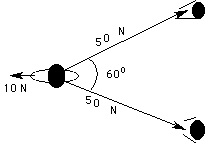
A 60 kg girl is on a skate board. Two people are pulling her on ropes angled 600 apart. A frictional force is acting on her of 10 N. Given the tensional forces are each 50 N, calculate her acceleration.
Soln; First we must find the sum of the two forces in the ropes. We do this by vector geometry.
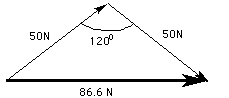
The total force by the ropes is 86.6 N forward but the friction will oppose this so
net unbalanced force on the girl = 76.6 N=ma
Thus, a = 76.6 / 60 = 1.27 ms-2
Weight; Weight is the Force of gravity and is NOT the same as mass.
= m g
We feel our weight because of the compression of our skeleton due to the ground supporting us . Without the ground support,we would feel "weightless".
Unbalanced weight will cause us to accelerate in the direction of our weight - we fall !
Partially balanced weight happens when we roll down a hill on a bike. The hill pushes at right angles to its surface so it cannot cancel the weight. We accelerate due to the resulting unbalanced force.
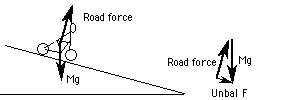
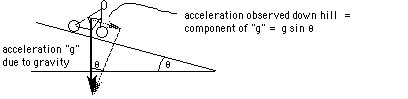
If we work through this carefully, the resulting unbalanced force turns out to provide an acceleration which is equal to the component of "g" down the hill. We are assuming no friction from the ground or air resistance.
Terminal velocity is an interesting situation arrived at when something falls in a fluid like air. We have all noticed that a feather does not accelerate for along period, it quickly reaches a situation where it drifts gently down.
At first, the body in the medium will accelerateas the only force is gravity. But as soon as it starts to move it encounters the medium around it which provides a drag force acting against its motion.
The drag force increases rapidly with velocity ( roughly proportional to v2 ), until it equals " Mg", the force of gravity. At this stage terminal velocity is reached.
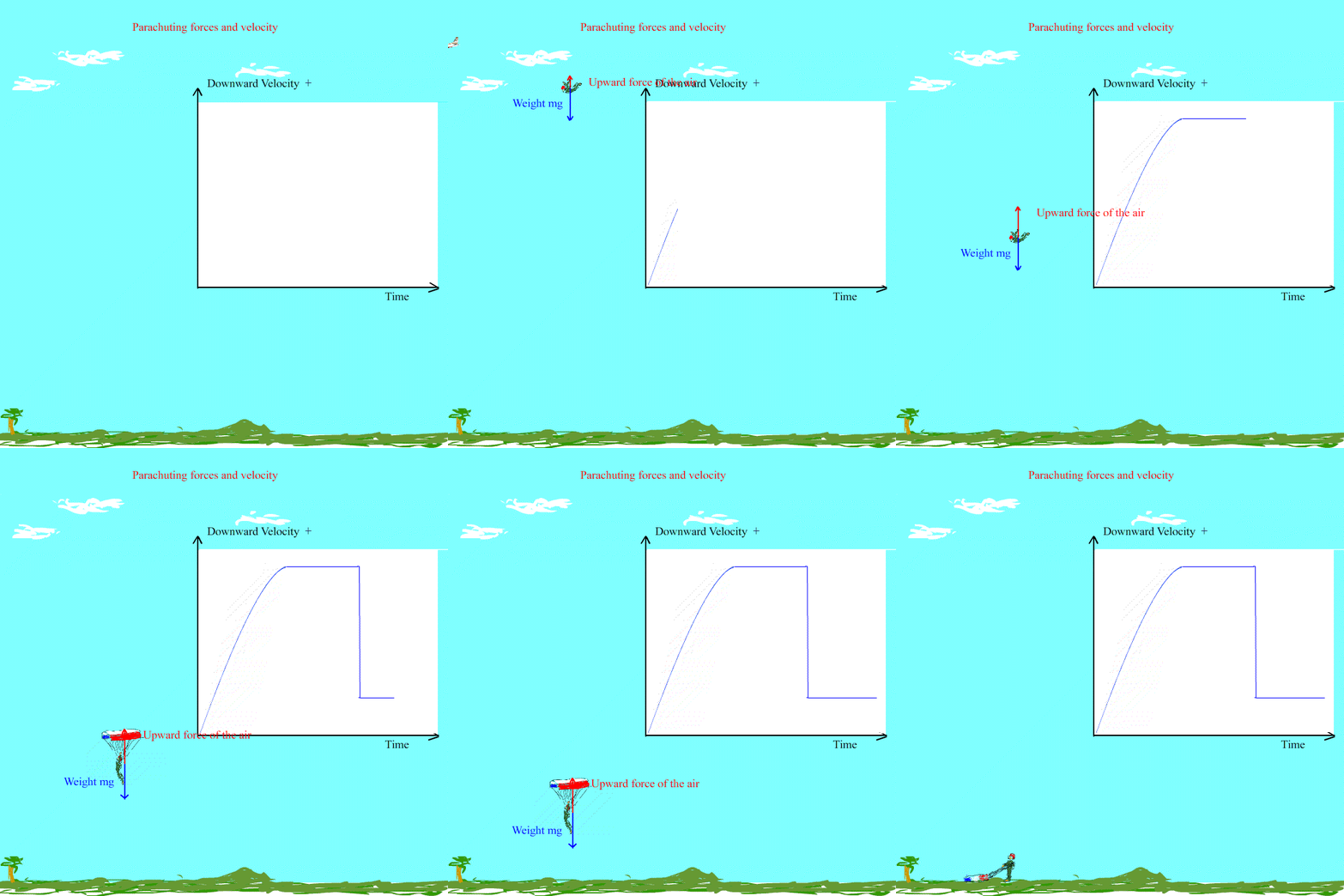
The size of the Terminal velocity reached depends on the mass and shape of the falling object, the fluid and thelocal gravity.
Drag is a force on any moving body in a fluid and is the force which balances a plane's engines when cruising. It isalso the major force on a car balancing the car's engine at higher speeds.
"When A acts on B with a given Force, B acts on A equally but oppositely."
This law is closely linked to Conservation of Momentum and can be derived from it or vice versa as Newton did in the Principia. Essentially, if something gives motion to something else, it has to use a force. In doing so, however, it gets motion as well in the other direction. The other object has pushed back.
Examples;
( Suppose that the ground did not push back equal to your weight , then you would accelerate down - the floor would have broken. On a trampoline, the floor pushes back with a force bigger than your weight so you accelerate upwards. )
The law works with all forces.
We see some things change their momentum more obviously than the partner in the interaction, the reason being the different masses of the partners.
Newton's Three Laws were remarkable advances.They set the ground rules for modern physics and in 99.999% of the occasionsyou come across, they hold. They hold for bridges, ships, hockey, cricketand are good enough to navigate the Solar System by.
BUT , we now know that while momentum always works, in some circumstances Newton was wrong! The genius of the man understood the limits of his work but had no way of testing those limits. Einstein found the limits and extended them so that Newton's work is now understood to be an excellent approximation in limited circumstances to Special and General Relativity and Quantum Mechanics.
Ironically, while we have found theories which seem to supersede Newton, we require two disparate ideas; General Relativity for the Universe and Quantum Mechanics for the world of the very small.
Two dimensional, advanced work on Forces
PROBLEMS
1. A 1.2 tonne car (a Micro) is accelerated from the lights at 1ms-2. What unbalanced force do the wheels exert on the ground? ( 1.2 x 10³N back)
2. Your friend is pushing you on a skateboard. Your mass is 55kg and, over a 3 second interval you start from rest to finish at 5 ms-1. With what unbalanced force have you been pushed? What force did you exert on him throughout the acceleration? ( 91.7 N forwards, 91.7 N backwards )
3. You are unfortunately involved in a car smash at 60 kmh-1. Make a rough estimate of the unbalanced forces acting on you if your seat belt stops you in 0.1 seconds as opposed to flying through the windscreen to be stopped by a wall in 0.001 seconds. Which is preferable? Why should seat belts be replaced after any accident?
( ~ 104 N , ~106N)
4. You have stepped into quicksand! AAAAArgh! Your mass is 50 kg but the sand only provides an upward force of 450N.What is the unbalanced force acting on you? What acceleration will you experience as you sink to your doom? ( 40N down, 0.8 ms-2 down)
5. Two fervent admirers are tugging at each of your arms. Menolly is pulling right with a force of 50N while Jack is pulling to the left with a force of 51 N. Who will win? If your mass is 60 kg,how much will you accelerate?
(Jack, 0.0167 ms-2)
6. (You are likely to muck this one up.) You are a great hockey player. The ball (0.14 kg) comes towards you at 2 ms-1and is sent directly back at 4 ms-1 . The impact is in 0.01 seconds.
What unbalanced force do you impart to the ball to hit it back?
( 84N away from you)