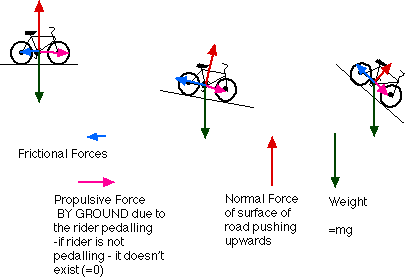
Applying Newton's Laws to situations relies on
RARELY ARE THERE MORE THAN THREE OR FOUR FORCES AT THIS LEVEL.
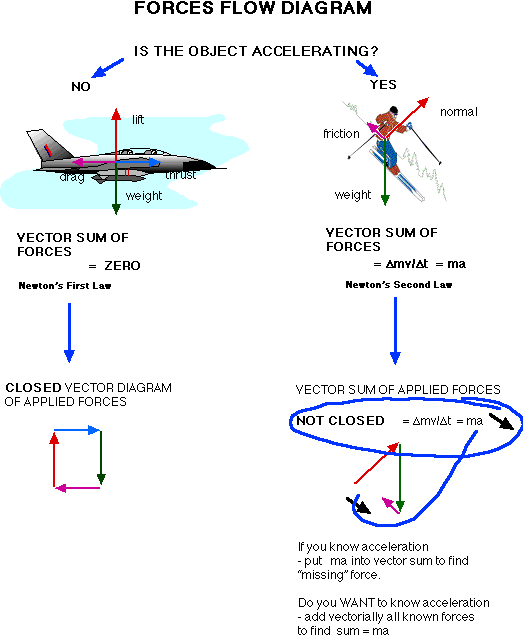
BALANCED OR UNBALANCED
?
The key to understanding and utilising Newton's Second Law
Example
The skier, mass 70 kg, above is accelerating down the 400 slope at 6ms-2. Find the drag force acting on her.
Solution:
Is she accelerating? - sure is - forces on her therefore add (vectorially)
to "ma".
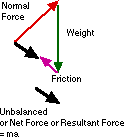
Unbalanced Force ( by Newton's Second Law ) = ma = 70 x 6 newton = 420 N down the hill in this case
Weight = mg = 70 x 9.8 N = 686N vertically down
Next we must sort out the angles so we can work on the triangle.
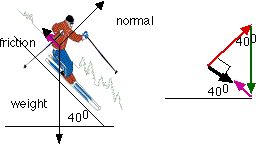
We have a right angled triangle with a 400 apex at the top.
Using simple trig, sin400 = Opp / Hyp = unknown / mg thus unknown = 686 x sin400
unknown = frictional force + ma = 440
thus frictional force
= 440 - 420 = 20 N
up hill.
Questions
Can we always use simple trig?
When must we use cos rule etc?
Can you see an alternative way of calculating the friction using components only?
Could you calculate the "Normal Force"?
What generally happens to the "Normal Force" as the slope gets steeper?