 FORCES
& NEWTON'S LAWS
FORCES
& NEWTON'S LAWS
FORCES
& NEWTON'S LAWS
FORCES
& NEWTON'S LAWS
Newton was a remarkable person living in what was, by our standards, a primitive, third world country. England three hundred years ago, had an appalling road system, you walked, went by horse if you were rich, or by coach if you were amazingly wealthy. Most walked. Most of the population was entirely illiterate (modern estimates put literacy at between 35 to 50%), living in the country and confined to a radius of about 10 km around their village.
The number of educated people was limited to those who had the money and inclination to learn. Newton's Mum was barely literate and she had plenty of money! Most of these people lived in London, Oxford or Cambridge.
Education meant then, a deep learning in Latin, some English, Greek and theology. Numeracy was limited to adding, subtraction etc. However, in the centres of learning in England and Europe it was possible to find a rapidly developing understanding of algebra culminating in the works of Descartes.
Science also had begun a sense of formalism in Astronomy through Kepler's discoveries though it must be realised that alchemy was quite accepted and astrology only just displaced amongst the learned.
So, to be interested in "Natural Philosophy" meant that you probably had money and certainly you had a Bachelor's Degree in Arts ; -namely in Latin, theology and Greek !
When Newton began to think on motion, he was also thinking on the problem of Gravity and Kepler's Laws. His thinking began, trained and heavily influenced by Aristotelian teaching of ancient Greece, with "common sense" notions. These ideas are still with all of us today and take a GREAT DEAL of shaking off !
Try testing yourself honestly with this exercise.
" What force or forces act on a car to make it move at constant velocity?"
A very common answer will be "the engine" - ONLY - which is wrong !
It is Aristotelian thinking - a "mover" is necessary to keep something moving - the engine !
( Does a golf club remain in contact with a ball to keep it moving ? )
Descartes and his contemporary, Galileo had already overthrown this thinking but 30 years later, Newton had to rethink it through and to formulate more complete rules for the behaviour of forces.
FORCES CHANGE MOMENTUM !!!!!!!!
What do we mean by the term "force"?
Lets start with our idea of a "pushy - pulling " sort of notion ; -
A rope pulls directly along its length - "tension"
A magnet attracts or repels another magnet
Gravity attracts masses
Jane shoves Bill
We can split these into, crudely,
( The "contact forces" at the atomic
level turn out to be electrostatic in nature - "noncontact". )
Pulling or pushing have a distinct sense
of direction,- all forces have this sense of direction, we must treat them
therefore as vectors.
The crucial idea that we need to hit on is that of BALANCED or UNBALANCED FORCES.
** If the vectors geometrically add up to nothing - we have BALANCED forces.
(Eg; A child's trike is pulled equally in opposite directions)
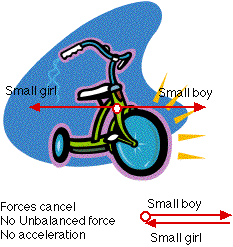
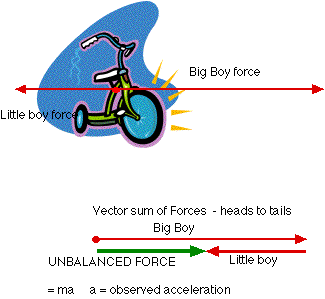
** If they do not add to nothing, ( a gap exists in the arrow addition ), then the forces are UNBALANCED.
(Eg; A big kid pulls the
trike away from a little kid)
KEEP THESE IDEAS IN MIND FROM HERE ON !
NEWTON'S FIRST LAW OF MOTION ( The Law of Inertia )
The interesting thing here is that constant velocity is a result of balanced forces - anything which is moving at a constant velocity has either no forces acting on it or effectively no forces acting on it !
The car travelling at a constant velocity has
effectively no force acting on it - a force must exist to cancel out the
engine ! ( Two forces also act vertically. )
When working with forces, it is very important to be able to identify all of them acting on the object of interest; - some of the common ones in everyday situations are;
friction - which always acts against the movement
weight = force of gravity - which always acts towards the centre of the Earth
surface normal force - a surface, such
as the ground supports you against gravity, it acts upwards at 900 to the
surface ( normal to the surface ). All surfaces can exert such 900 forces.
Newton's First Law is really saying that a body
in an isolated state maintains its own momentum - for ever !
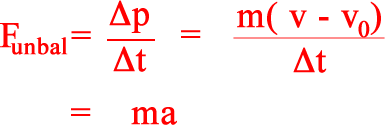
"The unbalanced force acting on a body is equal to the rate of change of momentum."
If the forces acting on a body do not cancel out , we see a change in the body's momentum - OR - if a body's momentum changes an excess of force must exist.
( Other words are used for "unbalanced force" - "net force" and "excess force" are two common alternatives )
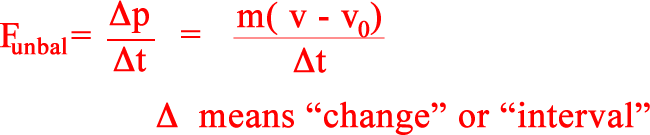
In many simpler cases, however, the mass of the system does not significantly alter so it is the velocity alone which alters. Eg; you are given a big shove - your mass does not alter but your velocity does alter.
When the mass does not alter
( PS; Change ALWAYS = final value - initial
value,
we often write, Δ
= change = final value - initial value )
The usual unit for force,
which is compatible with metres, seconds and kilograms is the newton,
N.
Eg 1; Your body,
mass 70 kg, is stopped in a car due to an accident. The car, mass 1000
kg is stopped in 0.1s from 110 kmh-1 .
a) What is the average unbalanced force on the
car ?
b) What is the average unbalanced force on you
if, as you have not got your seatbelt done up, you stop in 0.01s on the
bonnet of the car?
c) You do have your seatbelt done up and you
stop in 0.3s ?
Soln;
a) It is necessary to convert 110 kmh-1
to ms-1 before we begin.
110 kmh-1 = 1.1 x 10⁵ mh-1
= 1.1 x 10⁵ / 3600 ms-1
= 30.5 ms-1
Now , Funbal =Δp
/ Δt = m( v - vo ) / t
= 1000 ( 0 - 30.5 ) = -3.05 x 10⁵
0.1
The minus sign shows that the force it encountered is opposite to its velocity. ( Your car is a write -off! )
b) Using the same formula, except the values inserted are different
Funbal =Δp / Δt = m( v - vo ) / t
c) With the seat belt done up, you are stopped in a longer time interval as the seat belt stretches. The time interval is 30 times greater than previously so the average unbalanced force is 30 times smaller. Funbal = -7130 N this is possibly survivable. NEXT PAGE