AC vs DC
AC power is different from DC in that both the voltage and current swing in direction back and forth one cycle every 1/50 s making a sine wave. The terminals thus have no fixed positive and negative value but at any instant are one or the other. This means that AC systems are actually turned off twice in 1/50 s. (Moving a hand rapidly in fluorescent light gives a slight stroboscopic effect - the hand appears to jerk instead of move smoothly. This is directly attributable to the hand being illuminated, thus seen by the eyes, in flashes.)
Alternating Current is produced almost accidentally by the generators used by power companies. The generators have rotating magnets and as these swing north to south and back, AC is generated. Obviously they are designed to do it but DC machines do exist.
The "240" volts produced is a special averaging to give a pure DC equivalent. In actual fact, our power supply swings between +339 and -339 volts.
The advantage of AC over DC is that power transmission is simpler under AC, it can be changed in voltage relatively easily using transformers, and that higher power motors can be devised under AC. Disadvantages also exist such as energy loss in radiation and in eddy currents generated in nearby metals. Further problems can exist when the swings of voltage and current get out of time with each other.
While Australia and many countries use 240V DC equivalent and 50Hz, other countires such as the USA use 100V and 60Hz.
3-phase AC electricity.
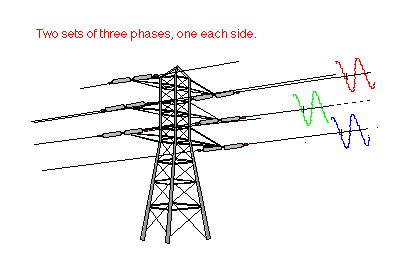
You may have noticed that very high voltage
transmission lines are always in groups of three, not two as you would
expect (one going, one coming back). This is because of
· a peculiarity of the generation system
· a trick used by electrical engineers.
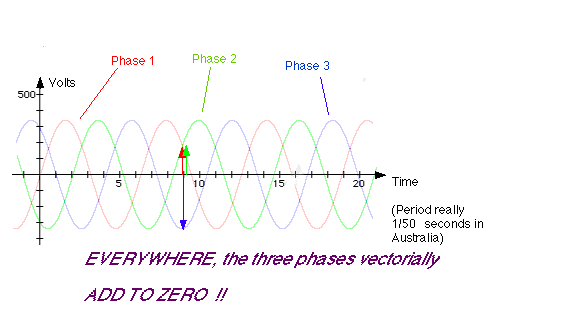
When the magnet spins in a generator, three outputs of electricity are created, not one. Each is coming to a maximum at a different time to the rest, "they are out of phase to each other by 1200" . Each of the three lines carries one of these three outputs. But where is the return line for each to the generator? This is where the trick comes in. Three identical waves out of phase by 1200 add to zero!!!!! So the engineers tie the other ends together and plant the, now single end, deep in the ground. If a slight residual remains, it seeps back through the ground.
At substations or transformers on a power pole,
the three phases are distributed around the local houses although all three
phases may be used in very powerful commercial equipment.