This is measured in units called coulombs, C, after Charles Coulomb who made the first precise measurements of the effects of charges on each other way back in 1785. In chemistry thus far, charge is merely referred to as 1+ or 2- or +3, it is enough to merely refer to the number of electrons lost or gained.
A man by the name of Robert Millikan actually made a precise measurement of the electronic charge value early this century.
It turned out to be extremely small, -1.6x10⁻¹⁹ coulombs. From what we know of the atom and the number of them in a crystal, we should not be so surprised.
Current (I)and charge are linked through time. Effectively, to measure current we count the passing electrons in one second and ask ourselves, "how much charge has passed?"
The formula which applies linking these elements is
Current
= Amount of charge passing
time in seconds
The unit of current is coulombs per second or ampere ( amp, A).
In symbol terms
I = ΔQ
t
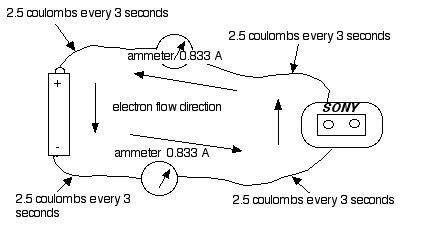
eg Suppose 2.5 C of charge pass a point in a wire in 3 seconds, what current is flowing?
Solution;
Using the formula I
=
ΔQ
t
I = 2.5
= 0.833 amps
3
An instrument called an ammeter placed in the circuit in this particular case would show this number.
Notice how many electrons are passing in the 3 seconds
number passing = 2.5 /1.6x10-19
= 1.56 x 10¹⁹electrons
- a truly colossal number! (Mind you, your body contains about 1029 electrons.)
(The electron flow is anticlockwise in this case as the AA battery has + at the "top" and - underneath.)
Notice that the total current remains the same right around this simple circuit. Current is not used up in a circuit! Remember the rafts representing electrons? Energy is "used up" in the sense that it is transferred from the battery to the player.
Conventional Current Flow
Now for something that is mildly insane, is annoying and causes great mirth to some (chemistry) teachers.
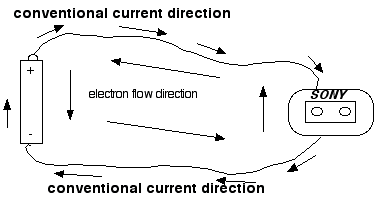
For purely HISTORICAL reasons, current is conventionally described as going from positive to negative! The opposite way from electron flow!
(What happened is that current direction was decided as going from positive to negative well before anyone - least of all chemists - had any idea of electrons' existence, let alone their being negative! By then too many books were written and too many people trained to easily change!)
ANY moving charge constitutes a current, electrons, ions, protons. That means that protons flowing in space between teh Sun and Earth say, is a current and here the current is positive charge flow so the conventional current now is the same as the particle flow.