
RELATIVISTIC TIME INTERVALS back to ether back to relative motion back to Einstein
This is also called "Time Dilation" ( - dilation meaning "opening" )
Lets look at an alien ship passing us on Earth really fast at v. The Alien is to measure the speed of light using a light bulb, measuring tape and stopwatch. A pulse of light is to travel from the ceiling to the floor beneath.
He will get the speed of light - 3 x 10⁸ ms-1. The experiment is carried out in his spaceship so it is a PROPER. set of measurements ( "Proper" measurements are done in the same frame as the experiment - this time the spaceship).
We will watch from Earth and observe the experiment and carry out our measurement of the speed of light. Our measurements will be RELATIVE as we are not with the experiment in the spaceship.
We will get the speed of light - 3 x 10⁸ ms-1
The alien measurements
The time interval for light to travel from ceiling to floor, d, is ΔT0 , the Proper time interval
so c = d /ΔT0 = 3 x 10⁸ ms-1
Our measurements
Our stopwatch will give us a time interval we will call ΔT, the Relativistic time interval.
Unfortunately, to us, the light goes down a diagonal as the spaceship moves forward from floor to ceiling a distance vΔT. Our RELATIVE MEASUREMENTS will seem entirely different.
| Using Pythagoras' Thm, we see the light travel | 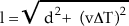 |
| so the speed of light is then also |  |
| Do some very simple substitution for d and we get | 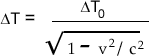 |

Our time interval differs from the alien's time interval for the same event! This is true for any time interval
eg between birth and death!
The alien is measured by us to live 50 years and he is passing at 0.9c. What is his proper lifespan?
Proper time interval = Rel Time interval / γ = 50 x 0.436 = 21.8y
He really lives 21.8 years.
RELATIVISTIC TIME INTERVALS > PROPER TIME INTERVALS
Relativistic effects on unstable fundamental particles.
If they are travelling very close to the speed of light such as in a cosmic ray shower or at the end of an accelerator, then according to us, they have a much longer half life than their proper half life. This is observed in all such experiments.
Example; In 1941, a classic experiment by Rossi and Hall looked at the subatomic particles called a "muon" was carried out. Muons are created by cosmic rays in the upper atmosphere and have a proper half life of 2.2 x 10⁻⁶s.
If they are travelling at 0.994c then the range before half decay should be merely 660m should special relativity not apply. However, time dilation means their relativistic half life - the half life seen by Earth bound observers - should be 20 x 10-6s and the range would be about 6000m. This is what was found by the above experimenters.
Problems
1. A pion is created high in the upper atmosphere 200km above sea level. It descends vertically at a speed of 0.99c and disitegrates, in its proper frame, 2.5 x 10⁻⁸s after creation.
What is its perceived endurance and hence at what altitude is it observed to disintegrate? ( 17.7 x 10⁻⁸s, 199,947m )
2. A spaceship flies past an Earth bound observer with a relative velocity of 0.8c. A stopwatch is allowed to run for 10s in the spaceship. The Earth bound observer also has a stopwatch which she operates according to the start and stop of the spaceship watch. What time interval does the Earth bound girl measure? ( 16.7s )