Detecting the ether. back to Relativity, Special Relativity
This is closely linked to measuring accurately the speed of light in the first place. This ain't easy. Galileo had a try using lamps but failed miserably.
The first realistic measurement was by the Dane, O. Roemer, in 1675 - before the Principia of Newton in fact (1686), when he noticed a discrepancy between the predicted positions of the moons of Jupiter and observed at different times of the year. Using the then best measurements for the Solar System sizes, he calculated a value for the speed as about 200 000 kms-1 , right ball park but not a home run.
By 1871, physicists were beginning to look for the ether by trying to see its effects on light of distant stars. From 1725, it was known that the position of a star appeared to vary according to the velocity of Earth in its orbit - the "Stellar Aberration Effect" - sort of like the way rain looks to change its angle of falling as you run at different speeds through it. This is because the light has a velocity as has the Earth, you, and they combine vectorially to give a slight angle away from that if Earth were stationary so the angle of the telescope varies.
Using a water filled telescope, Airy tried to see the ether and failed. Mark one up.
Another speed of light nutter, Fizeau, started using interference where light from a source is split then passes through two paths before coming together to create an interference pattern. One path was through flowing water, the other air. He was trying to see the effect of water on the ether.
The definitive attempts were the series of tries were by A.A. MICHELSON who attempted to compare the speed of the Earth at 30 kms-1 with the speed of light, 300 000 kms-1 through interferometry.
The equipment he devised is being used today on a huge scale for detecting Gravity Waves at the LIGO and VIRGO facilities. ( Link 1, Link 2 )
In 1881 he had results.
PS; Michelson enjoyed measuring the speed of light up to his dying days.
The Michelson-Morley experiment.
Why the path difference?
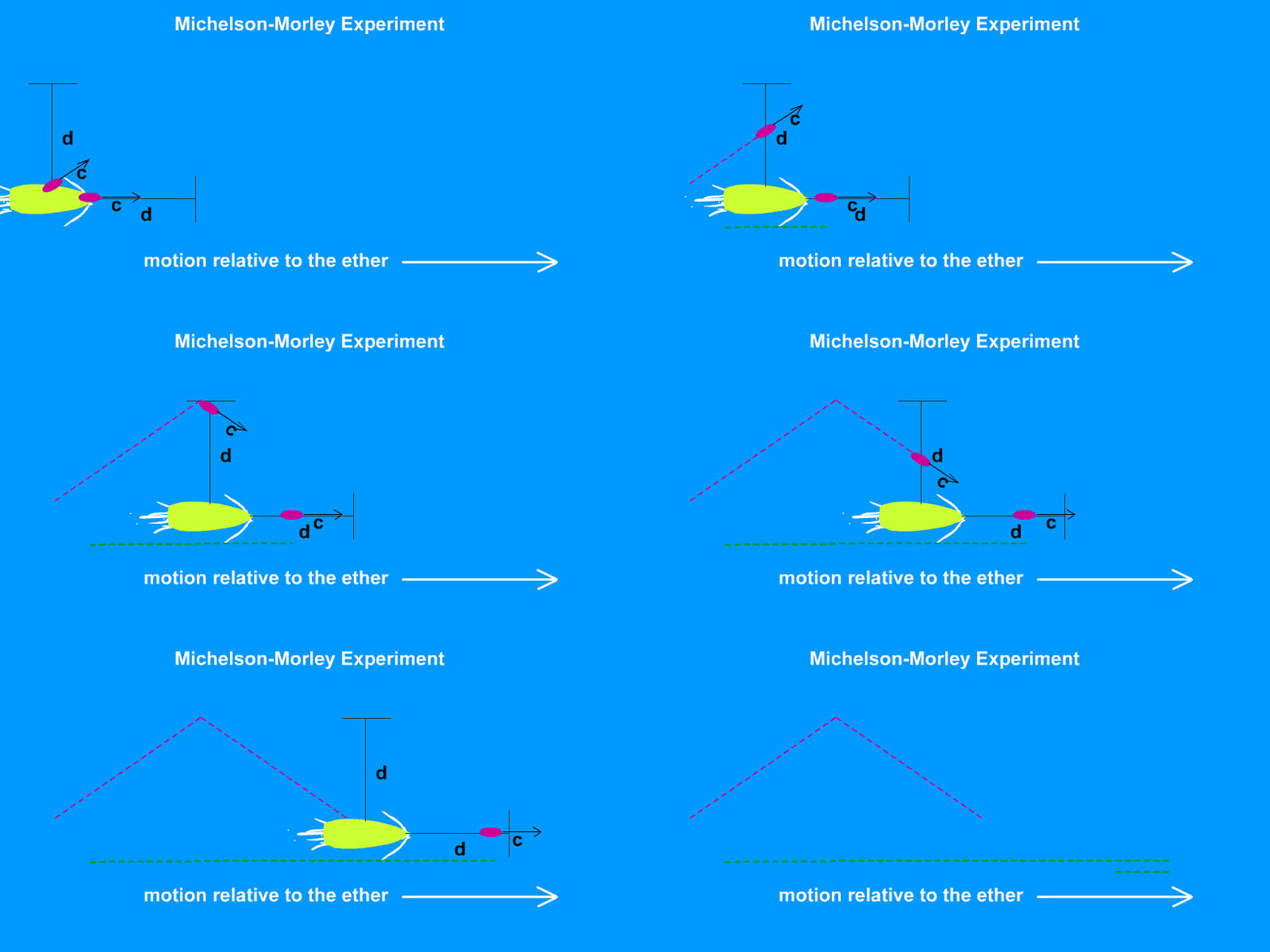
Consider the animation below of a ship ( Earth ) with two diving platforms at right angles to each other. One is off the bow into the water going past, the other is off the side. Gantries are placed off the bow and over the side with targets ( mirrors ) to swim to.
Two identical swimmers ( light ) dive off each board to reach the targets. The bow swimmer has a hard time reaching his target as he must swim towards a retreating target. Getting back will be easy as the boat is coming towards him.
The other swimmer, however must swim in a diagonal to his target and a diagonal back. The total distance of each is different - a Path Difference. Light should take different times to traverse each arm
.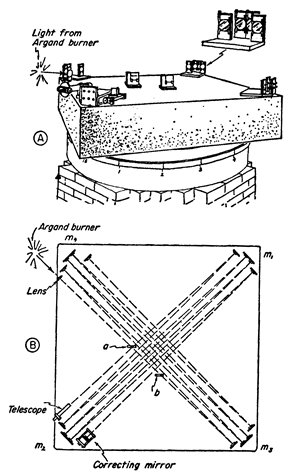
The experiment should have easily shown the relative motion. Improvements were made over many years to increase sensitivity. The whole thing was mounted on stone and floated in mercury on a plinth down to bedrock. The arms were increased in size using more mirrors. The experiment tried at different times of the year.
IN ALL CASES, pattern change was WELL below predicted. The better the sensitivity, the poorer the result.
QUESTION - DOES THE ETHER EXIST?
Physicists refused to be put off the ether. Lorentz proposed that ether passing though a material actually changed the length of the material to make the ether not appear to exist. His theory led to a series of equations known to this day as the Lorentz equations.
Einstein arrived at the same equations by a totally different route.
(Poincare may well have arrived correctly at Einstein's theory before Einstein!)
(LIGO can detect path differences as small as one thousandth the diameter of a proton!)