POTENTIAL ENERGY AROUND SPHERES topics
When we measure Potential Energy , Ep, of two spherical masses ( M,m ) or charges ( Q,q ) a distance r between centres, we find that the old formulae of "mgh" or "qEd" no longer work as the field strengths, g or E get much weaker with distance due to the 1 / r2 effect.
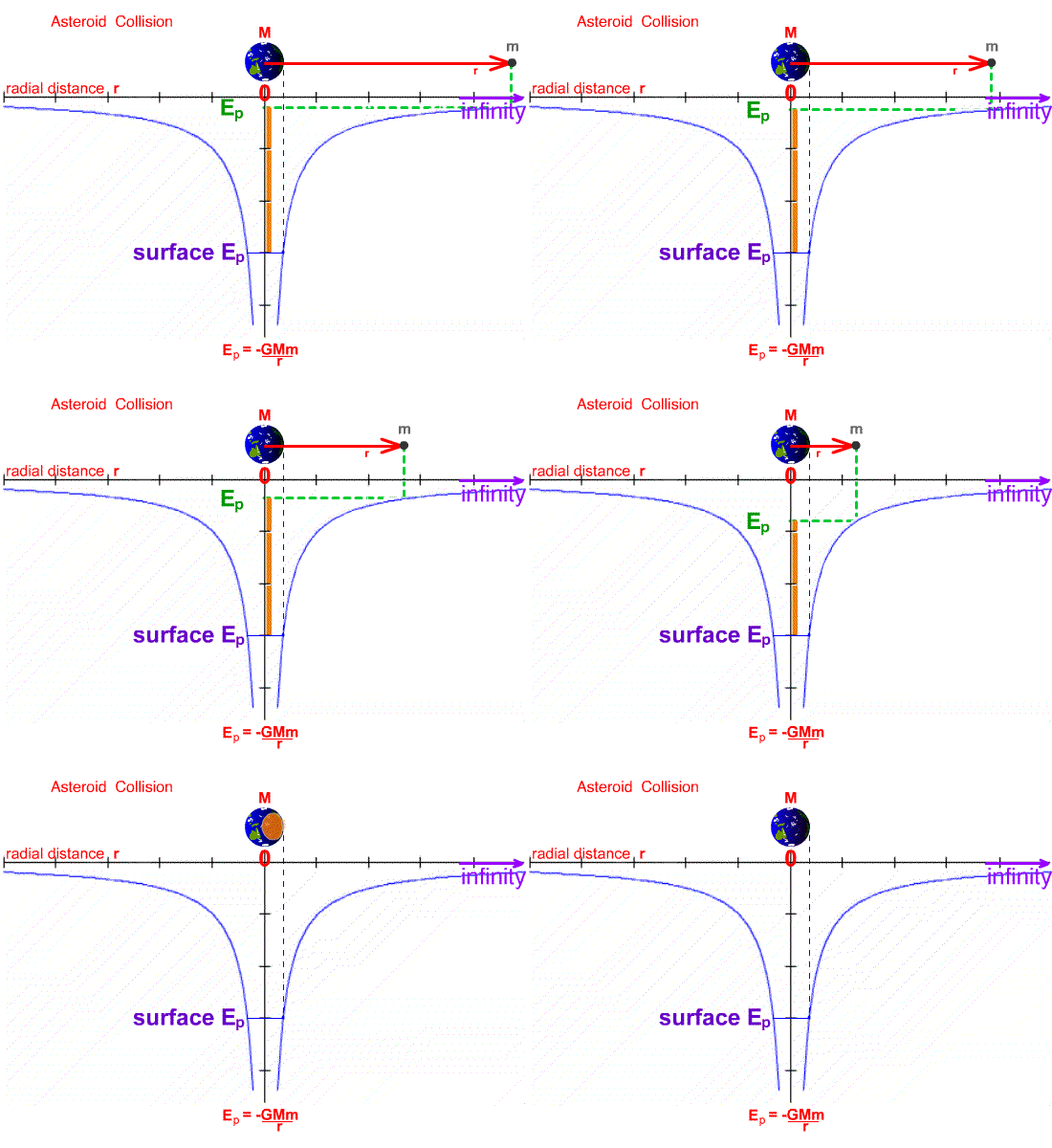
When we were working from Earth's surface, we measured + as above the surface and - as below. This will not work now, objects which have zero potential energy will be at infinity. As we approach an attractive body, our potential energy will fall from zero into the negative! As we approach a repulsive body, they have the same charge, our potential energy rises from zero into the positive.
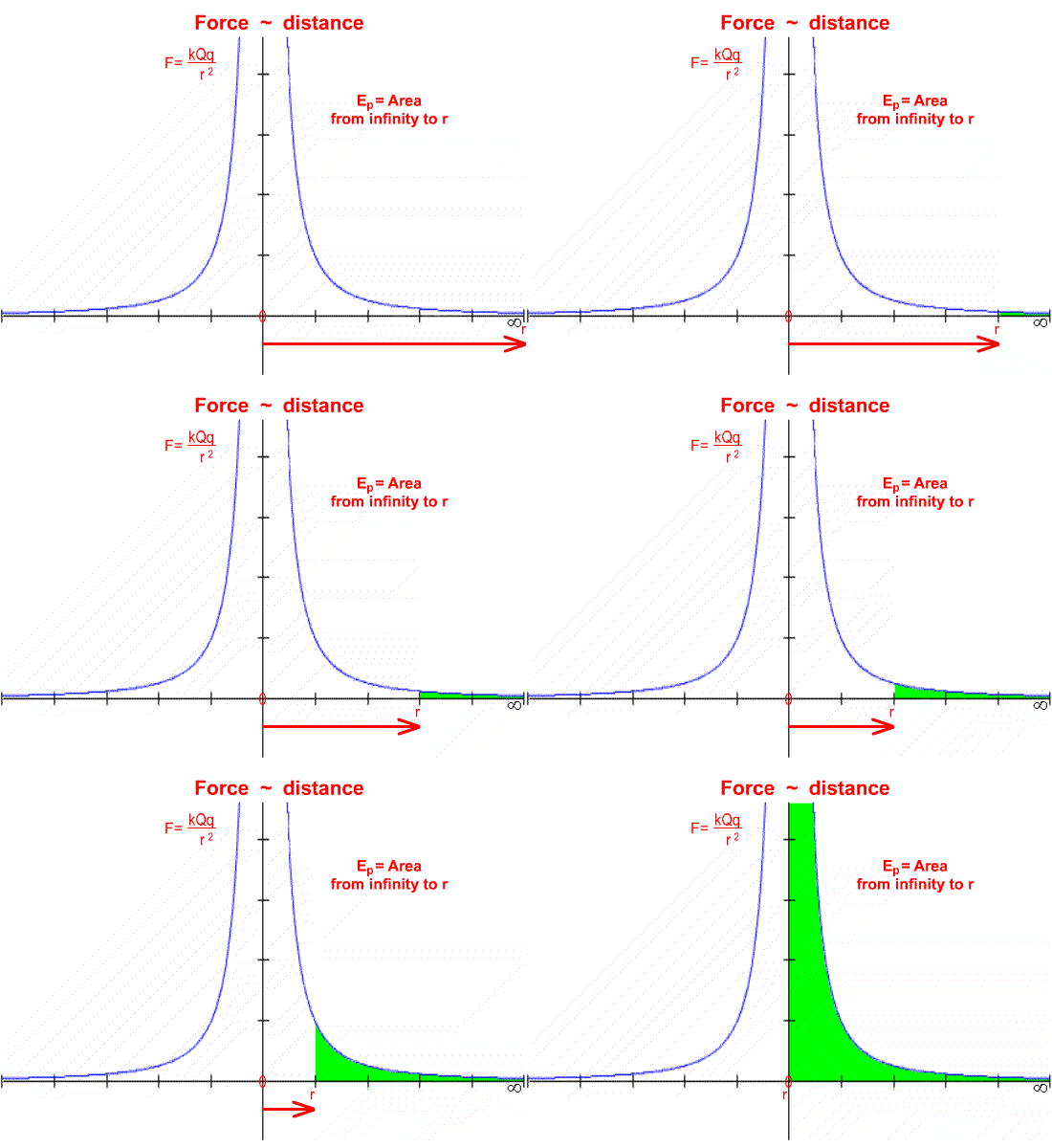
Ep is area under the appropriate "Force ~ distance" graph. We have to find the area from infinity INWARDS to the place of interest as otherwise we get ridiculous results ( due to the vertical asymptote at r = 0 for the technically minded ).
The forces are F = GMm / r2 ( atttraction only ) gravity and F = kQq / r2 ( attraction and repulsion ) for electrostatics.
To find this area, we perform a piece of calculus called integration. ( see derivation )
We get Ep for gravity = -GMm / r and Ep for electrostatics = kQq / r
The minus for gravity is because of the attraction between masses, electrostatic potential energy can be plus ( for repulsion ) or minus ( for attraction ).
NOW NOTICE - as r inceases, the potential energy GOES TO ZERO! At infinity, objects have ZERO potential energy!
In attractive situations, potential energy is NEGATIVE , a potential energy well or hole and increases to zero with distance.
In repulsion, the potential energy is POSITIVE and DROPS with distance to zero at infinity, a potential energy hill.
Eg; The potential energy between Earth's centre and the Moon's centre is
Ep = -G Me mm / r r = distance between centre of Earth and centre of Moon.
= - 6.67 x 10-11 x 5.98 x 1024 x 7.35 x 1022/ 3.8 x 10⁸ J = - 7.7 x 1028 J
This is negative. It is measured compared with infinity which is zero. It is the energy lost coming from infinity to 3.8 x 10⁸ m of Earth.
What about between the surface of a large planet and centre of a small rocket? This is what we are really used to as potential energy - a comparison of potential energies.
Ep = -G Mm (1/rdistant - 1 / rsurface )
BETWEEN TWO PLACES, WE SUBTRACT individual potential energies.
Eg; What is the potential energy of a 2 tonne satellite 800km above the Earth's surface?
Soln; We have two radii, the Earth's radius to the surface and the orbital radius to the centre.
Ep = -G Mm (1/rdistant - 1 / rsurface ) = - 6.67 x 10-11 x 5.98 x 1024 x 2000 (1 / 7.2 x 10⁶ - 1 / 6.4 x 10⁶ ) J = 1.39 x 10¹⁰ J
( Compare this with "mgh" taking g = 9.8 ms-2 , h = 800 000m and the mass as above , 1.58 x 10¹⁰ J . Gravity gets weaker as we go up so the potential energy compared with Earth's surface is smaller than the old formula predicts. For rocket makers, this is VERY important - less fuel is needed. )
The same applies for electrostatics. SUBTRACT potential energies for each radius.
POTENTIAL at a POINT in a radial field.
This usually is for charge but equally validly can be applied to gravity.
By definition,
V at a point = Ep / q where q is the "test" charge.
Thus V = kQ / r ( For gravity V = -GM / r negative, because of attraction. )
ZERO volts is at infinity. Near negative charges the potential becomes increasingly negative while for positive charges, potential becomes more positive.
Eg What is the Potential 5cm from a charge of +6μC ?
Soln; V = kQ / r = 9 x 109 x 6 x 10-6 / 0.05 = 1.08 x 10⁶ volts
Hence, what is the Potential Difference between 5cm and 6cm?
Soln; At 6cm , V = kQ / r = 9 x 109 x 6 x 10-6 / 0.06 = 0.9 x 10⁶ volts.
Thus the PD between 5cm and 6 cm is (1.08 - 0.9) x 106 volts = 1.8 x 10⁵V We subtract.
V = kQ (1/r2 - 1 / r1 )
If we have multiple charges, we need to calculate individual values of V and use arithmatic!