BOHR - RUTHERFORD HYDROGEN ATOM topics
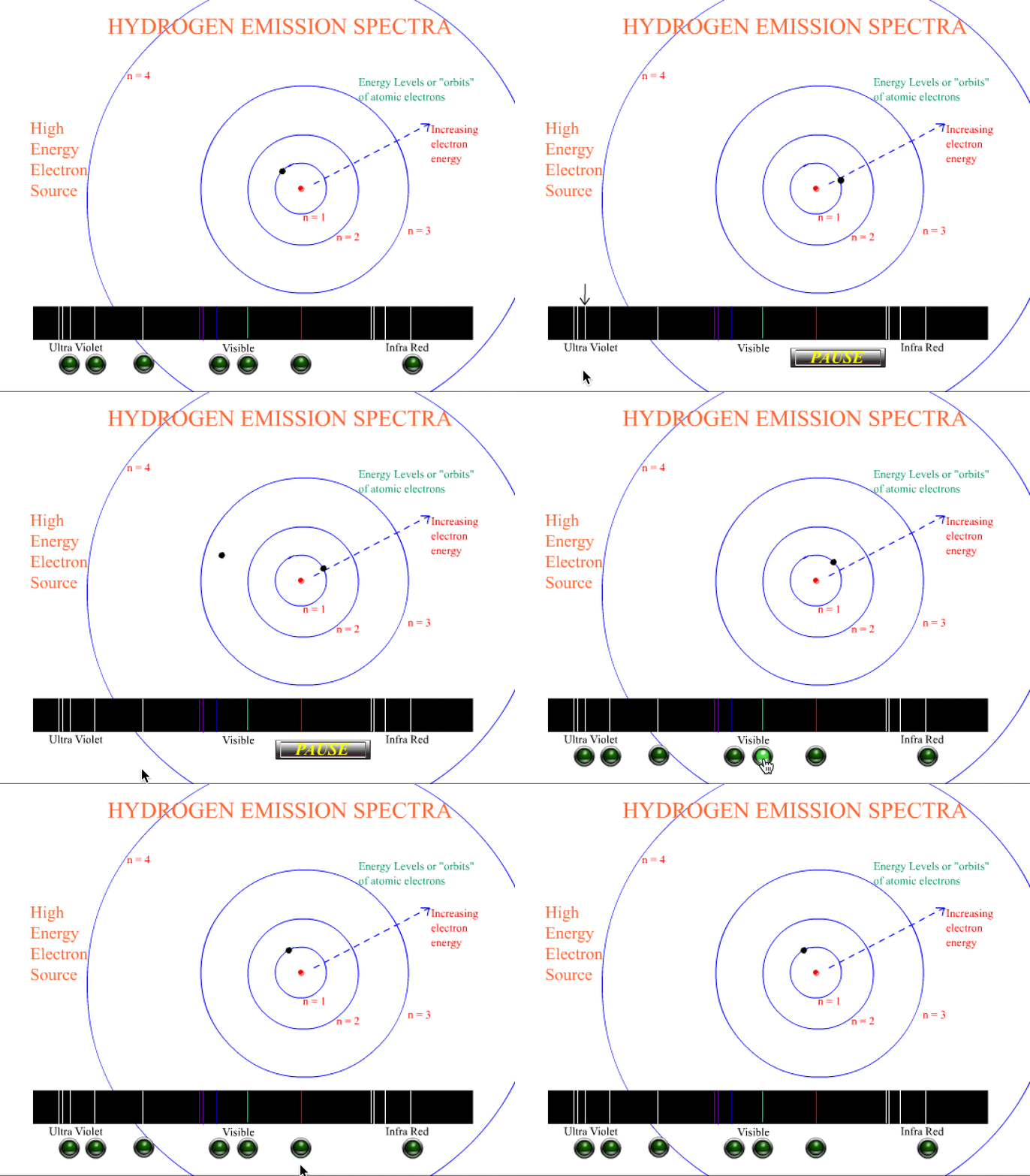
This model of 1913 improves Rutherford's original nuclear model by placing restrictions on the possible "orbits" of the electron. It is the "Grade 9 - 10" atom that is divied up as a standard representation.
We start by calculating the total energy = sum of potential and kinetic energies of the orbiting electron
and we equate Coulomb's Law with the necessary centripetal force for orbiting.
(1) F = k e2 / r2 = mv2 / r e = charge on both electron and proton = 1.6 x 10⁻¹⁹ C
From the above Ek = 1/2 mv2 = k e2 /2 r (2)
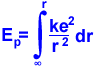
Ep = Work Done in moving charge from infinity to orbital radius =
= -k e2 / r
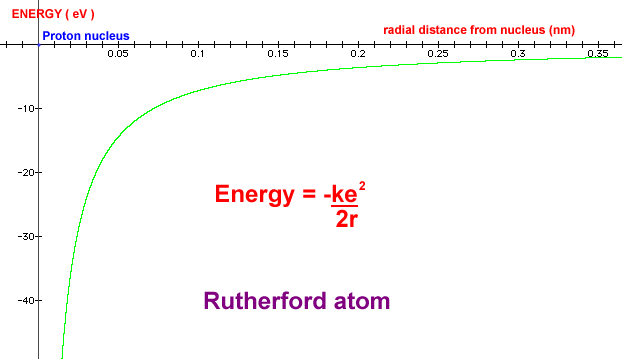
so the total energy E = -k e2 / 2r . (3) (Notice the energy is "negative' - that simply means that infinitely far away is taken as a "sea level" or zero.)
This equation allows any old radius and energy. Rutherford put it up. It does not solve emission lines. It also has a weakness, the electrons are accelerating ( circular motion ) thus should be radiating radio waves! - losing energy - spiralling in - exit atom.
Enter Niels Bohr
LET (for the hell of it) linear momentum x radius mvr = nh /2π where n = 1,2,3,4,....... (positive integers), h = Planck's Constant
Now to fiddle to sus out the consequences - basically we are going to return to total energy again after wiping out speed.
Square the lot, and reorganise mv2 = ( nh /2π )2 / mr2 = k e2 / r from (1)
OUT OF THIS COMES A RESTRICTION ON ORBITAL RADII
r = n2h2 / 4π2kme2 n = 1,2,3,4,.............
Stick this in a calculator
for n=1 r = 0.53 x 10⁻¹¹ m
n = 2 4 x this value,
n = 3 9 x this value .......
When we bung this back in the Energy equation (3) to get
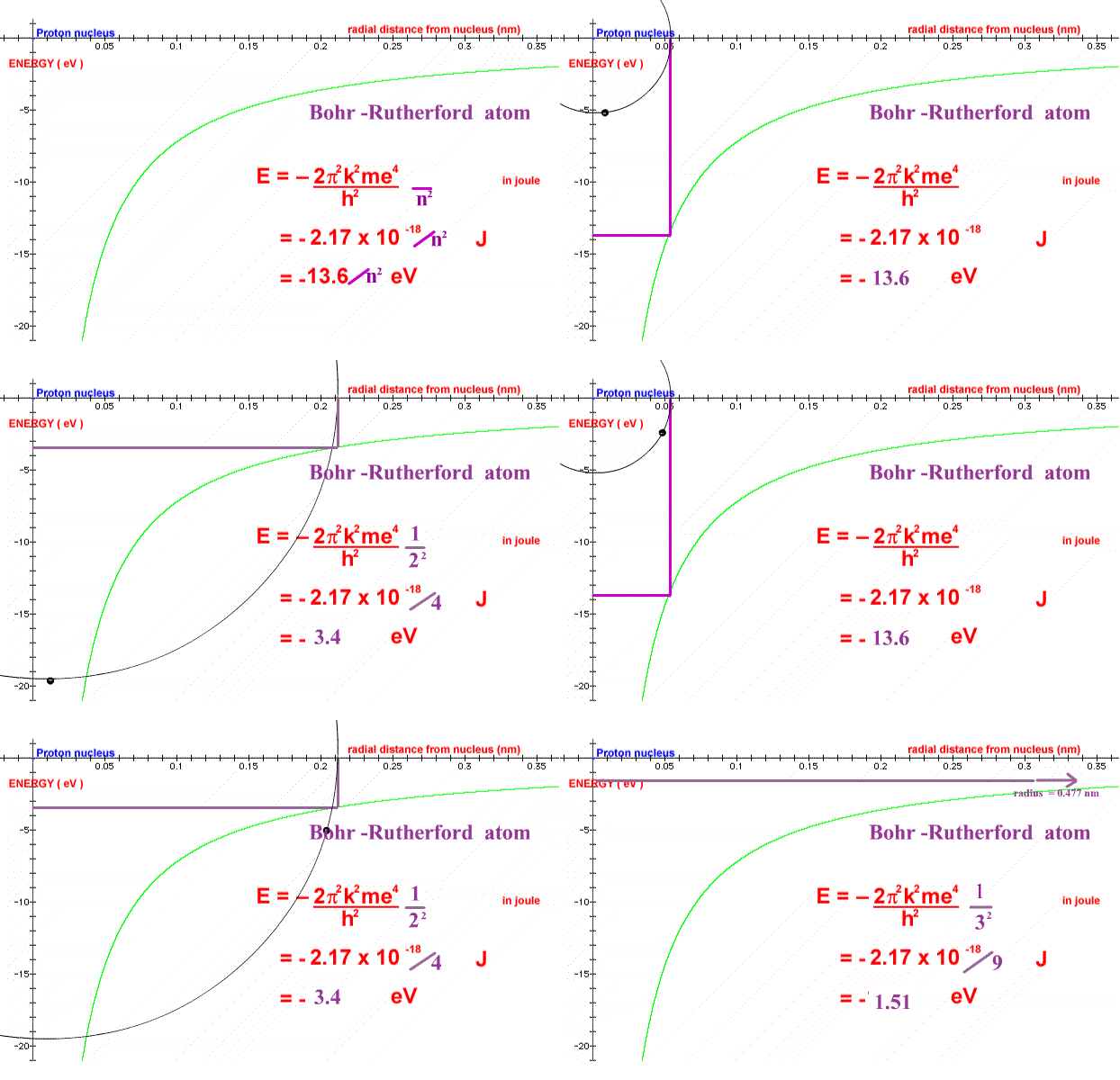
E = - 2π2k2me4 / n2h2 (4)
Energies are restricted!
Next guess by Bohr - ASSUME DOWNWARD CHANGES IN ORBITS by electrons are accompanied by light emission = energy difference between orbits
Then
ΔE = 2π2k2me4 (1/m2 - 1/n2) = hf = hc/λ where m = 1,2,3,..... & n = 2,3,4,5,.....
h2
thus 2π2k2me4 (1/m2 - 1/n2) = 1/λ
h3c
OH WOW! the Rydberg formula !!!! and it works really well for the spectra of hydrogen.
How to interpret this?
"Promotion" of an electron outwards requires energy. This can be due either to
"Demotion" of an electron inwards releases photons exactly matching the energy changes from orbit to orbit
Only certain orbits exist corresponding to diameters of 0.106 nm, 0.424nm, 0.954nm, ........
and the energies corresponding to these orbits are, on substitution in (4) and converting to eV,
-13.6eV, -3.4eV, -1.51eV .......
Jumps downwards between orbits lead to the spectral patterns -