Lasers
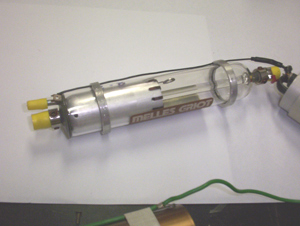
He-Ne laser tube
The term "laser" originally stood for "Light Amplification by Stimulated Emission of Radiation". It can only be properly understood through quantum mechanics. It is the AMPLITUDE or "brightness" that is enhanced by the process.
The mathematical background began with work by Einstein in 1916 working on the statistics of electrons in versions of the Bohr Atom. However, the full mathematics and understanding did not come until much later.
The immediate precursor to the laser is the maser, a microwave equivalent invented in 1955 that occurs in nature in interstellar gas clouds! The first laser was a single crystal artificial ruby device by Maiman in 1960. Continuous gas lasers came in the 1960s while LED lasers appeared in 1970.
Many different lasers now exist, the most common being in digital communications. Virtually every house now has at least one - in their CD/DVD players and recorders! Many materials can be made to lase, gelatine was once made to, then eaten!
Characteristics of Laser Light.
Laser light is
Some lasers can change colour - they are "tunable" - most are fixed. They now operate from the infrared to the ultraviolet - some way off versions powered by atomic bombs were said to operate in the X- Ray region. This has never been proved! X-Ray lasers ARE being developed however using electron accelerators.
COHERENCE
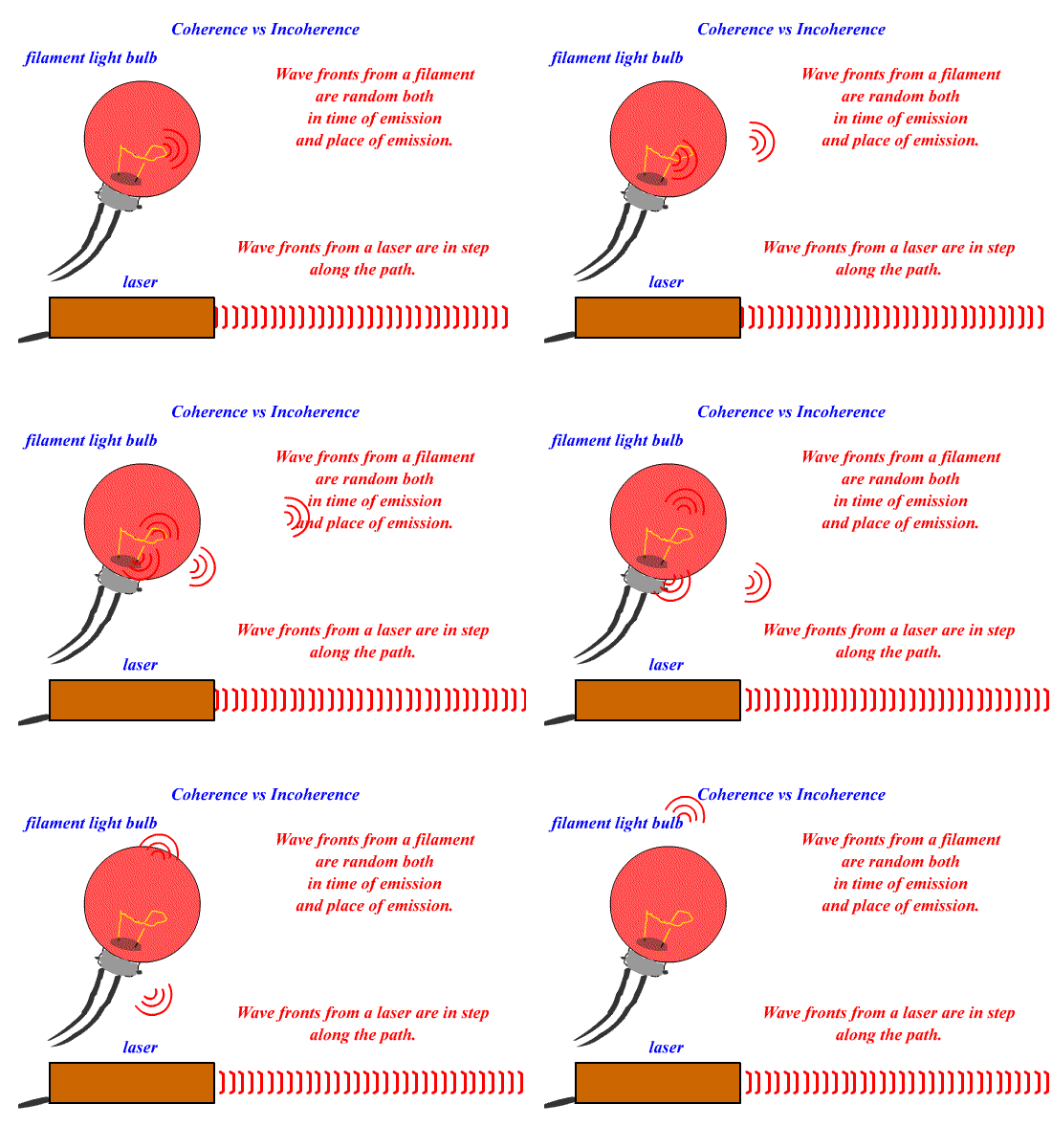
Most light sources are incoherent. A filament light used in every household, emits light due its heat ( related to blackbody emission ). The light emitted from one part of the filament has nothing to do with that from another part - or any other part - it is incoherent. It cannot be used for interference experiments. ( Wonderful word, "coherent". Cohere means "to stick together"; adhere, "stick onto". )
IF we then shine this light on a pinhole, we find that the pinhole light IS coherent. The light is coming from a source that is loosely the same size as the wavelength and we have spherical, organised light. Star light is also highly coherent, though light from the Sun is incoherent - distance makes the difference. Across a large distance, wavefronts from a star join to make one effective wavefront - coherent.
Coherent light most certainly DOES NOT have to be monochromatic! Thomas Young's pinhole experiment showing the wave nature of light in 1801 used candles! The slit ot the front of a spectrometer or spectrograph is to ensure coherency for the diffraction grating. Radio telescope interferometry relies on the coherency of distant sources in the universe.
The light from a laser is organised ( in phase ) right across the entire light beam all of the time! This is remarkable. The reason is simple, the light is from a small source and shows, therefore high coherence.
Upon emission, the light is clearly moving at the speed of light, as it must be. In terms of wave model, the waves have the same phase at any point in the beam. In terms of photons, they are in step, roughly like an army platoon marching in step, ordered, in ranks and keeping together.
MONOCHROMATIC
Lasers are monochromatic because the light is derived from electron transitions in the atomic energy levels. It is no different from light in a line emission spectrum, but confined to one transition for the lasing atoms. When the atom reverts to its ground state, the photon emitted causes the emission of other identical photons from other atoms.
COLLIMATED
Lasers are amplified along narrow shapes with mirrors at each end. Only these photons along the line of the of the amplifier, at right angles to the mirror, escape as the laser beam. They tend to spread only because of diffraction effects.