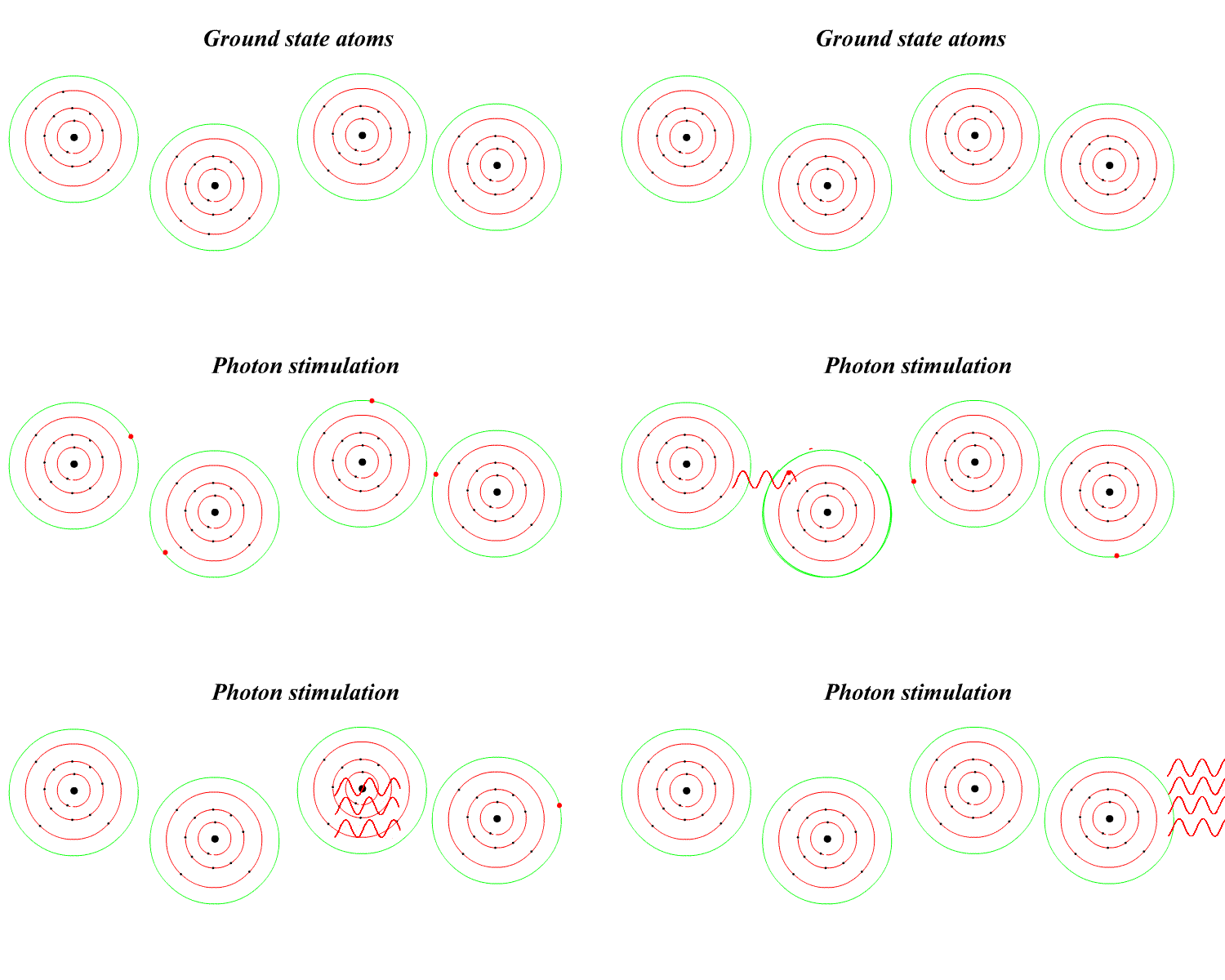
Lasing works by
1. having lots of atoms with suitable energy levels. These can be solid, liquid or gas!
2. promotion of electrons to the suitable higher level - "exciting" or "pumping" the electrons
3. maintaining sufficient of these "excited states" - a population inversion
4. allowing photon emission as the electrons fall back, hence allowing photon stimulation
5. providing an amplifying situation.
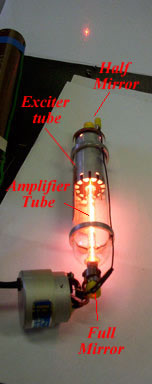
Exciting or pumping the atoms - is done in many ways. For a gas laser such as a helium-neon laser, one way is use a side tube in which a high voltage current is passed through some of the gas. This excites the main gas tube. Irradiating the gas mixture with photons from a secondary mixture encasing the tube is another method. Photons of appropriate wavelength are absorbed and the electrons raised to the higher levels. For a semiconductor laser, the simple act of passing a current through the diode in the forward direction guarantees electrons at an energy above the valence level at the junction. The original ruby pulse laser was excited by being encased in a powerful flash light. Population Inversion For successful lasing, more atoms need to be "excited" than nonexcited - in fact a good majority! When the lasing material is in this state, it is said to have a "population inversion" of electrons. Photon Stimulation is the key to the process - it has been found that if a photon passes an atom that is suitably excited, its electromagnetic fields interact with the atom and cause the atom to emit another identical photon perfectly in phase and moving with the first photon. The atom must then be reexcited. |
 |
The amplification
- is created usually by holding the lasing material in a tube or space with mirrors at both ends, one of which is partially silvered so light can escape. The tube acts like a flute, resonance takes place - standing waves are set up along the length and amplification takes place along the length the same as in a flute or microwave. Clearly the length must a whole number of half wavelengths!
Photons travel up and down the length of the tube or cavity stimulating more emissions so the laser light becomes stronger and stronger up to a maximum governed by the excitation process and the size of the amplifying resonance region.