MAGNETISM & SPECIAL RELATIVITY Return to magnetism topics
Historically and in high school education, magnetism is treated as a separate phenomenon to electrostatics though clearly related to it as moving charges create magnetism.
In class it is taught that
In the C19th, Faraday made many of the links between magnetism and electricity and light. Prior to his and Oersted's work, magnets were individual Magnetic Charges - hence Coulomb's Law of magnetism F = constant x qm x qm' / r2 that I was taught, but taught now rarely. No one has ever found individual "magnetic charges".
James Clerk Maxwell converted Faraday's nonmathematical work into the Maxwell Equations that very satisfactorily describe virtually all of electromagnetism. These predict the properties and the speed of light, including in transparent materials and were further confirmed by Heinrich Hertz with his discovery of radio waves. Maxwell's Equations are, to this day, key in understanding electromagnetism.
To do this he combined the equations of a number of predecessors, Coulomb, Faraday, Biot, Savart, Ampère, Gauss, Stokes and others with a term creating an additional symmetry between magnetic and electric field - whereas Faraday had shown that electric fields (voltages mean electrostatic fields exist ) could be induced from changing magnetic fields, Maxwell introduced the idea of changing electric fields inducing magnetic fields.
The equations are inefficient in a couple of ways. There are a number of starting equations required from the variety of discoveries concerning magnetism and charge. Induction processes were particularly looked at by Einstein.
Einstein's 1905 paper which became the "Special Relativity paper" was about Electromagnetism, the English 1923 translation is "On the Electrodynamics of Moving Bodies". His starting point is a discussion of the problem of inducing current by relative motion, that the two conditions of moving conductor or moving magnet are traditionally treated as separate actions when they are really relative motion effects.
If you place the usual ideas (Newton and Galileo) of relative motion on electromagnetism, then the speed of light must vary according to the actions of the observer - you should be able to "see" the speed of the Earth's orbit relative to light. There should be an "absolutely stationary frame" in which light moves - the frame of the "luminiferous aether". This was looked for by Michelson and Morley, and they failed to spot any relative motion of Earth to the speed of light.
But there are subtler "errors of symmetry".
To resolve these issues, Einstein put forward the famous proposition that the speed of light in a vacuum is fixed for all observers additional to the axiom that all the laws of physics operate everywhere. Under this assumption, magnetic effects are merely electrostatic forces appearing different because of relative motion! ALL forces appear modified when relative motion happens under Special Relativity- a result of light taking time to arrive at the observers' eyes AT THE SPEED of light.
With Einstein, ALL electromagnetism (including Maxwell's Equations,) can be derived from Coulomb's Electrostatic Law and Special Relativity ALONE. Special Relativity cannot be derived from Maxwell's Equations.
Here is a common version of the problem of magnetism and relative motion.
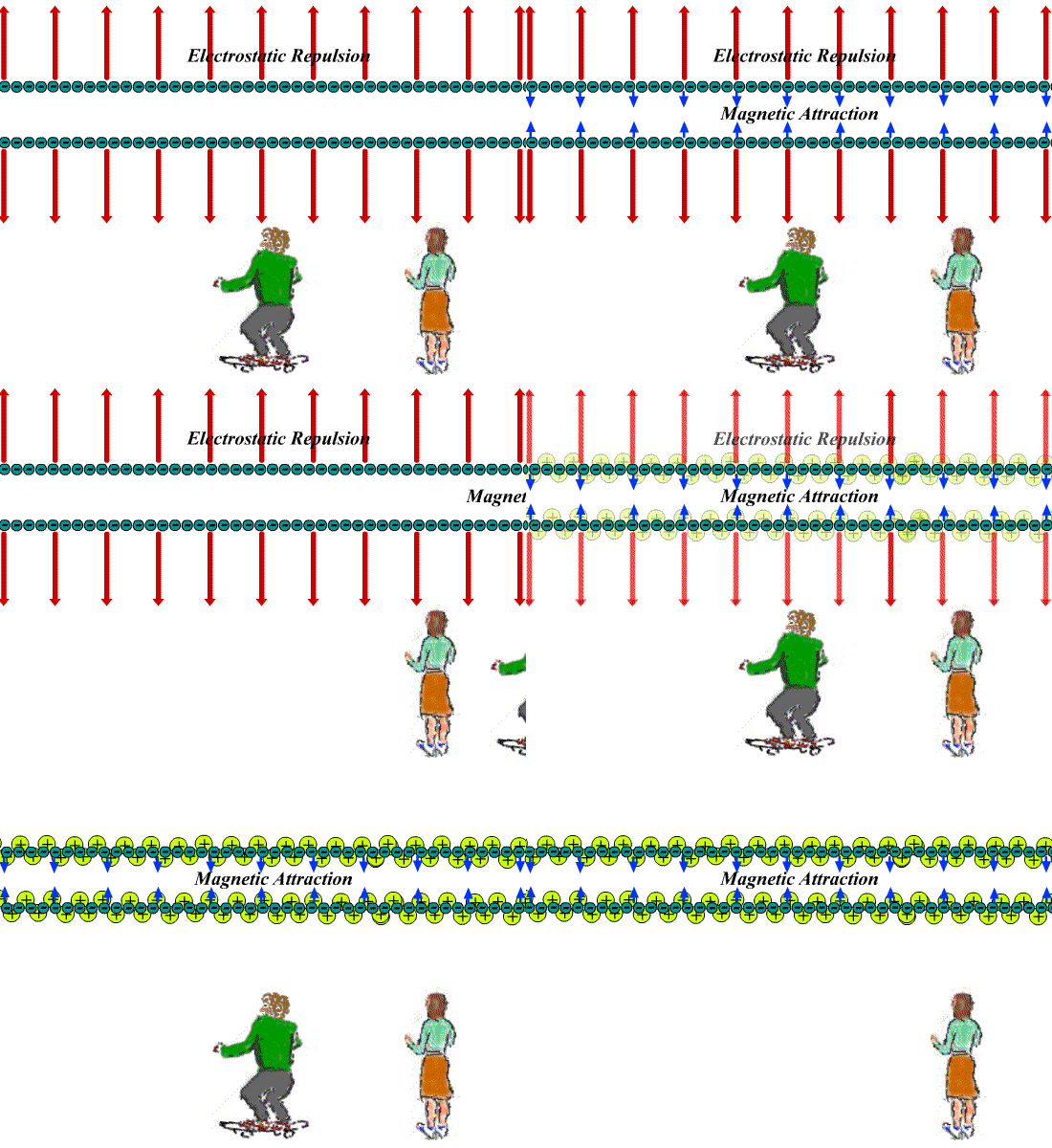
Consider two parallel rows of negative charges (electrons). An observer stands by them and watches them. They electrostatically REPEL. Using Coulomb's Law and a little calculus, we can calculate the forces.
Put the observer on a skate board and roll him past the lines of charge. The relative motion converts the lines of charge into currents! Currents are magnets, parallel currents ATTRACT. We can also move the charges past the observer and see the attraction, it is merely a matter of relative motion. If we have a stationary observer and a moving observer with the charges, they will NOT see the same results - magnetism will exist for one but NOT THE OTHER!
In fact the lines of charge always repel, but to a lesser extent when moving - the pure electrostatic forces are weakened. The faster the observer goes past them, the weaker the force appears to be. The force is affected by relative motion. This is symmetrical , the charges could be moving rather than the observer.
If we encase the moving negative electrons in a stationary wire of metal, then we still have the current, BUT THE WIRE IS NEUTRAL as the positive ions of the metal are everywhere canceling the electronic charge. What we now see is the difference between the stationary coulombic repulsion and the relative motion effect, the weakening. This ATTRACTION is the magnetic force by itself.
In other words, the magnetic force is just the result of relative motion of charge affecting the observation of the electrostatic force.
Electrons in a wire typically move at a 0.05 mm/second, hardly close to the speed of light. Yet the relativistic magnetic effect is easily observable because about 1018 electrons pass each second if 1 A is running in a wire. This amplifies the effect sufficient to become a clearly observable phenomenon.
excellent site University of New South Wales