Related Topics: Empirical Formula, Molecular Formula
This section deals with the determination of the ‘Simplest Formulas’ for molecular compounds. The simplest formula is also known as the Empirical Formula. It is different from the molecular formulas that we are accustomed to as the molecular formula is the actual ratio of atoms in the molecule while the simplest formula is the simplest ratio of atoms possible. For example, C4H8 is a molecular formula while CH2 would be the simplest formula.
Percent composition is the ratio by mass of the elements involved, as the examples below show.
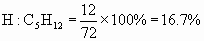
Example: What percent, by mass, of pentane (C5H12) is hydrogen?
Solution: One mole of pentane contains:
5 mole of C
12 mole of H
|
1 mole of carbon is |
12g, so |
5 mole is |
60g |
|
1 mole of hydrogen is |
1g, so |
12 mole is |
12g |
|
1 mole of C5H12 is |
72g |
Thus 83.3% of the compound’s mass is carbon.
Try these problems.
Related Topics: Empirical Formula, Molecular Formula