 Physics
is a subject in which motion is a very important topic. We call this study
Kinematics.
Physics
is a subject in which motion is a very important topic. We call this study
Kinematics.
Physics
is a subject in which motion is a very important topic. We call this study
Kinematics.
We are always aware of movement and we have words to describe it on a day to day level.
SPEED - we are going fast, or slow 180 kmh-1, 20kmh-1
DISTANCE - 120km, 40km
The terms used above are the most common every day words and we think we have a good idea of what they are. After all they are on the speedo of Mum's car! We can relate to them.
Thinking of the car gives other ideas - ACCELERATING - something to do with getting faster - the pedal on the right. The brake decelerates the car.
When we look more closely at movement, we find it can be far more complicated.
Or being thrown into the air?
Is there a difference between going to town and coming home?
When you are bushwalking or sailing a yacht, there is a big difference between the distance you walk or sail to your destination and the shortest path distance!
What about the distance from the petrol station to the left or right?
If we want to describe everything we did CAREFULLY we could have problems.
Try answering a simple question . How far did you go?
You could answer 100m or answer "nowhere"!
Both answers say something correct but they answer two different questions. We need two kinds of "distances"!
DISTANCE - The total accumulated travel in the given time.
- the 100m answer.
DISPLACEMENT, (s) - The distance directly between the start and finish, no matter how far it has travelled in distance, with a sense of direction.
- the "nowhere" answer.
The letter "s" is the usual physics symbol for displacement.
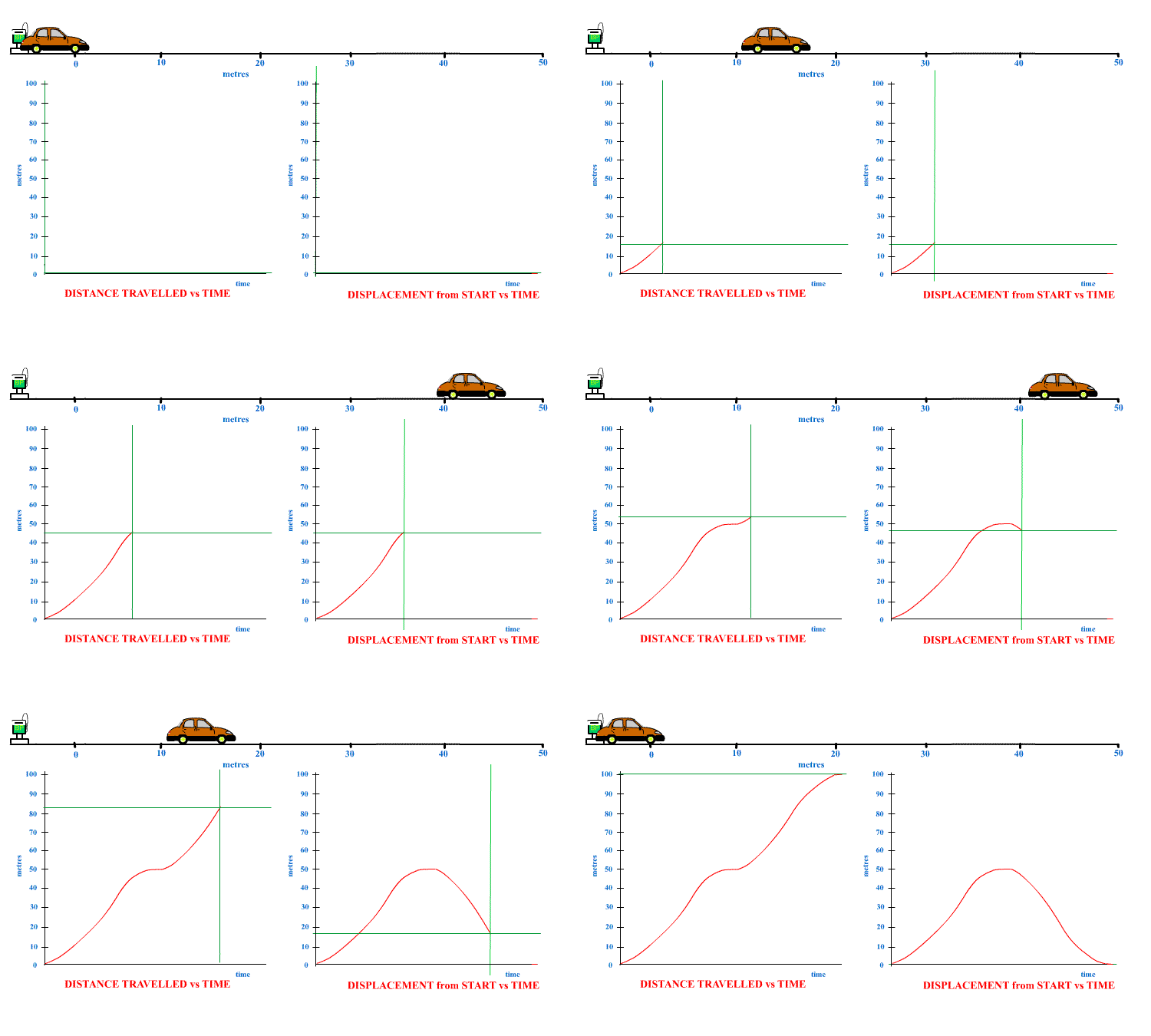
At times, distance and displacement may have the same value. But often they will NOT!
Let us look at the actual movement of the It "speeds up", "slows down", goes backwards, stops going backwards.
Lots of difficult questions.
What was your average speed?
How much did you accelerate ? - lots ?
AVERAGE SPEED - the TOTAL distance travelled divided by the time taken.
(commonsense really)
INSTANTANEOUS SPEED - the rate of change of distance at the instant of time.
This type of speed is how fast you are going at a given moment , like when you slid off the road!
What speed does NOT tell us is whether we are going left or right. We need a new term to tell us this called VELOCITY. Speed is related to distance, VELOCITY is related to DISPLACEMENT.
AVERAGE VELOCITY - the TOTAL displacement travelled divided by the time taken.
INSTANTANEOUS VELOCITY v - the rate of change of displacement at the instant of time.
Inst. velocity always has the same size as inst. speed but it also has a sense of direction.
eg. The car is moving at 30 kmh-1, 30secs after starting.
Its speed at 30s is 30kmh-1, but its velocity is 30kmh-1 to the left or right .
The difference between the average values is the following;
Suppose you travel from Ltn to Hbt and back in 4 hours. The total distance is 394 km.
average speed = total distance / total time = 394 / 4 kmh-1 = 98.5 kmh-1
average velocity = total displacement / total time
BUT the total displacement
= straight line distance between start and finish ( with direction )
= distance between Ltn and Ltn
= 0 !
Thus average velocity on this trip = 0
kmh-1 !
The last question we must look closely at is
getting faster or slower. We have used ACCELERATION to mean getting faster,
but now we shall make its meaning wider. We do this by linking acceleration,
not to instantaneous speed but to instantaneous velocity. The sense of
direction becomes important .
ACCELERATION a - the rate of change of velocity at an instant of time.
This turns into a simple formula -
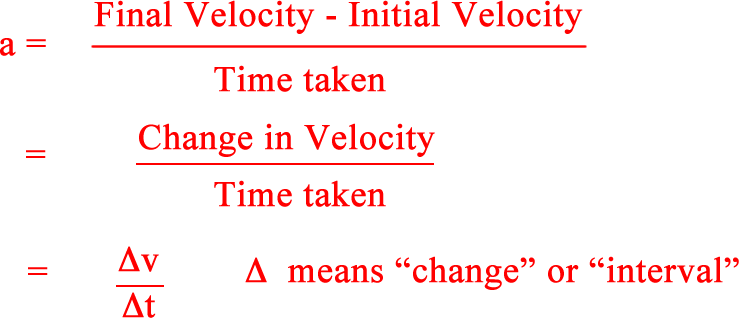
Accelerations may now be " getting quicker" or " getting slower". In the forward direction , taking it to be positive , getting quicker is a positive number but getting slower is a negative number. If however, it is going backwards, the negative direction, the reverse is true!
Eg. Let going to the right be positive (our sense of direction is linked to a Cartesian Coordinate system ) .
Suppose the car has an initial velocity of +20ms-1 which increases to +50ms-1 in 15s.
Then the acceleration is
a = Final v - init. v
t
= +50 - (+ 20)
15
= +30 / 15 = + 2 ms-2
The car now stops from +50 ms-1 in 4s.
a = Final v - init. v
t
= 0 - (+50)
4
= - 12.5 ms-2
If the car was going to the left ( taken as negative ) but the speeds were the same then the two accelerations work out to a = -2 ms-2 and a = + 12.5 ms-2 ! Check.
From here on s = displacement ,
v = velocity (inst ) ,
a = acceleration.
always !
Speed and distance are not used very often and never in the important formulae.
( One exception, "s" can also stand for "seconds" but the meaning in context is unambiguous. )