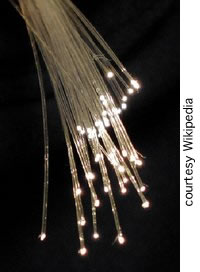
Fibre Optics
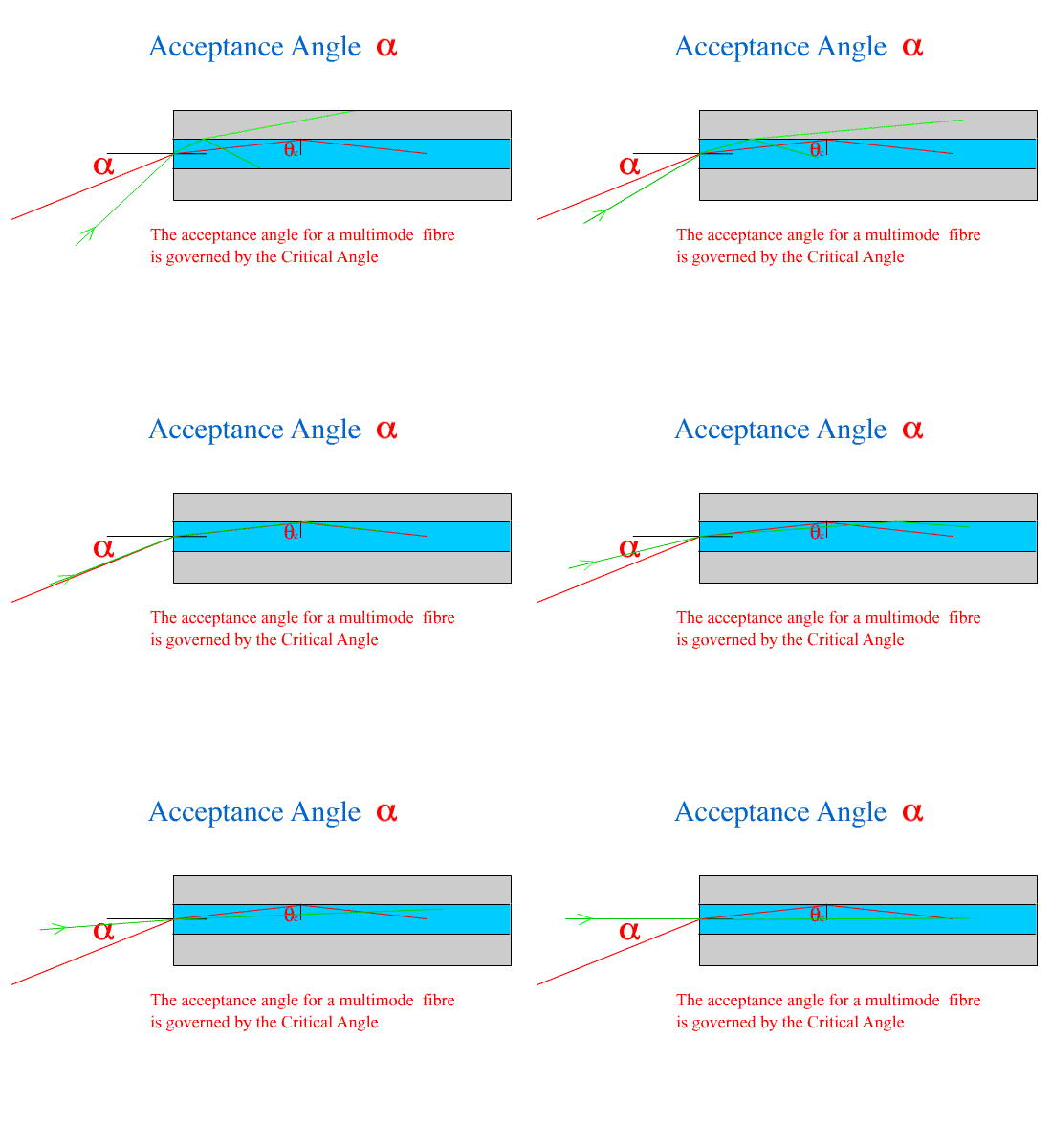
These are extremely common now in telecommunications, ethernets and diagnostic tools in medicine and other technology. Essentially they rely on total internal reflection and have a core of slightly higher refractive index than the outer coatings.
Two types of fibre exist, thicker, older designs called "multimode" fibres used for short range connections and endoscopes and long distance "single mode" or "monomode" fibres.
Modern telecommunications fibres must transmit with very little energy loss and very little dispersion of the signal.
In a typical fibre, a number of wavelengths in the near infrared are used simultaneously and are separated at the far end with filters and diffraction gratings.
Dispersion is the loss of the signal shape due to the varying refractive index of the glass core with wavelength ( - this same dispersion causes rainbows from water droplets and the spectrum from prisms). Why does this happen?
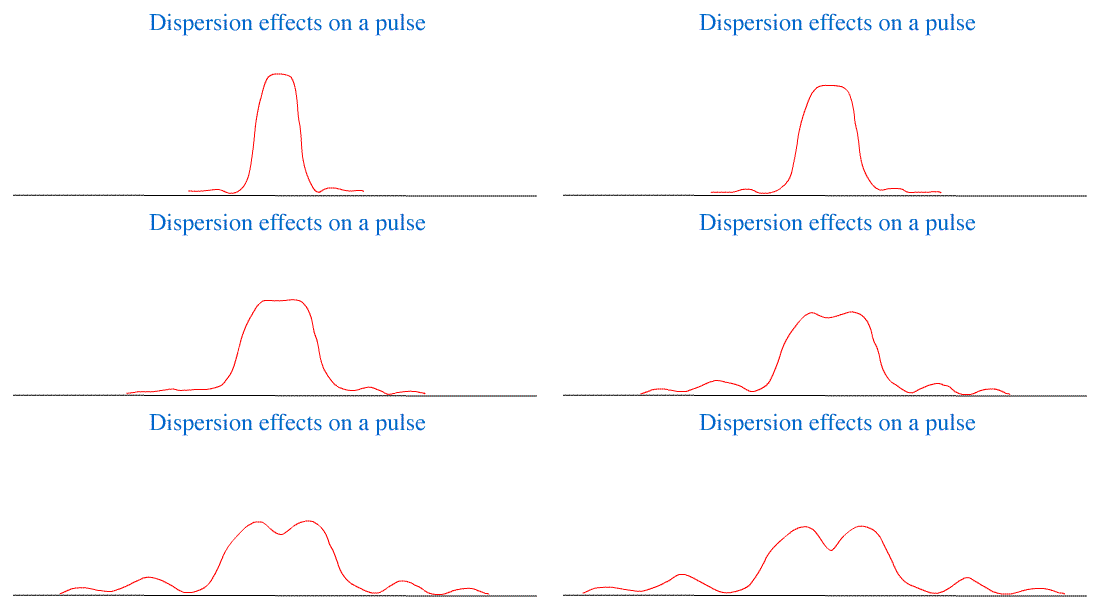
A modern signal is digital. Each part of the signal consists of "square" pulses of "off and on". The sensors at the end of the fibre respond to these to create the digital electronic pulses. Each optical pulse must be "sharp" enough to convert to a sharp electrical pulse. Soliton waves are now commonly used to maintain shape.
There are 3 main types of dispersion
Material Dispersion; A square wave pulse can be shown to consist of an infinite series of continuous waves added together. (This can be shown by Fourier Analysis - a standard analytical process of waves from the early C19th.) Each component wave has a different wavelength so sees a different refractive index and travels at a different speed. The square pulse therefore spreads out with time and distance. ( Much the same effect can be seen in the bow wave of a ship. It starts as a single wave but spreads out into a series of waves with distance travelled.) Optical amplifiers and signal regenerators are needed every few hundred km to recreate the signal and signal strength.
Some fibres are graded in refractive index from "low" to "high" centre to overcome this. (The ideal profile of refractive index is parabolic.) Large angled signals move in the "outer lower refractive" index areas so travel a little quicker than low angled signals confined to the central core. The pulse tends therefore to keep its shape better.
The problem is least in the 1300nm region BUT fibre loss is least in the 1550nm region!
Single mode fibres suffer from this problem.
Modal Dispersion; In a multimode fibre, each mode is operating at a slightly different wavelength hence sees a different refractive index. Each mode then moves at a slightly different speed! This is the most significant dispersion in these fibres.
The effect of modal dispersion can be minimised by making the core so thin that the light cannot "bounce" from wall to wall but is confined directly along the core. These are the "mono-mode" or "single-mode" fibres. The core is about the same order of thickness as the wavelength of the transmitted light - about 8 to 10µm. So act as waveguides.
Waveguide dispersion; a problem in monomode ( single mode ) fibres. In single mode fibres, the light is channelled as in a waveguide. However, different wavelengths see the channelling as slightly different - ( compare a small kayak in a narrow river to a larger rowing boat - the larger rowing boat is more channelled than the kayak because of its dimensions!) so dispersion occurs. It is possible to trade off the waveguide dispersion against the material dispersion so achieving good loss and dispersion properties.
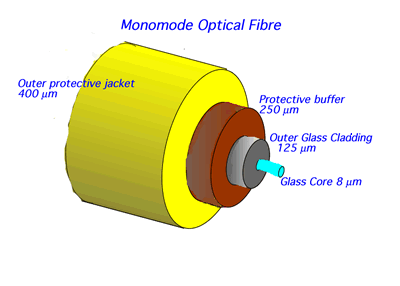
Loss of energy is the other major consideration. Most loss in these ultrapure glasses is Rayleigh Scattering - the same effect as makes the clear sky blue, whereby light is scattered from the vibrating atoms and molecules of the glasses. This effect is far less for red than blue ( proportionate to λ-4 ) so signal lasers used operate in the near infrared. Typical wavelengths are 1300nm to 1550nm. Losses are typically < 0.2 dB/km .
All intercapital ( 1550nm ) and metropolitan links ( 1300 to 1550nm ) in Australia are single mode. Single mode cable costs the same as multimode but is harder to connect up because of the smaller tolerances.
Fibre Optic endoscopes for medicine or for use in looking down small holes at hidden areas of gas turbine engines are bundles of fibres with lenses at the end. Mulitmode fibres are more than adequate for this purpose.
For more information try Wikipedia
http://en.wikipedia.org/wiki/Fiber_optic