Measuring Quantities In Chemistry
Close window when finished.
Please record your observations and answers to Questions 1-17 on a separate page.
In our early work we were mainly interested in observing the changes which took place when chemicals were combined. We were not particularly concerned about calculating the exact amount of each chemical used in the reaction. But clearly this is important, in fact almost as important as observing the changes.
Q1. List as many situations as you can where knowledge of quantities in reactions might be important.
So, we need a method of measuring the amount of chemical substances accurately. This might seem easy at first but remember:
We cannot count out atoms to see how many of them are being used in a reaction.
Q2. In our early experiments we used a "recipe" approach to our chemistry. Can you see any disadvantages to using this approach all the time?
Let's examine these problems one at a time. When we have a particle that is small, instead of counting out a number of those particles we use mass as a measure of how much we have.
Relative Lollie Mass
Experiment 1
We are going to use Tic-Tacs as example of a small particle.
Steps
1. Count out 20 Tic-Tacs and weigh them.
2. Using different Tic-Tacs weigh out the same mass of Tic-Tacs without counting them.
3. Count the Tic-Tacs weighed out in Step 2.
Q3. How many Tic-Tacs were equivalent to your first mass of 20 Tic-Tacs?
Q4. If you wanted to have a large number of Tic-Tacs, say 1000, what mass of Tic-Tacs would you weigh out?
Q5. Would it be easier to count a large number of small particles or weigh an amount that would give us approximately the correct number? Explain. (Do you think you could count out 1000 Tic-Tacs without making a mistake along the way?)
We have now decided (hopefully) that measuring a certain mass of atoms would be a useful way of obtaining a certain number of atoms, particularly since atoms are so small.
Experiment 2
Step 1. Weigh out and record the masses of:
(You will of course notice that the larger the lollie in size, the larger the total mass of ten lollies.)
Q6. Potassium atoms are larger than sodium atoms because they contain more protons and neutrons. Would 10 potassium atoms weigh more or less than 10 sodium atoms? Would one million potassium atoms weigh more or less than one million sodium atoms?
Step 2. Write down your mass of 10 Tic-Tacs showing it as equal to one new unit, which we might call a Tic Tac Toe, i.e., 7g. Tic-Tacs = 1 Tic Tac Toe.
Q7. If a Steam Roller has exactly twice the mass of a Tic-Tac, how many grams would 10 Steam Rollers weigh? How many "Toes" would this be?
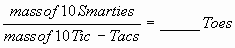
Step 3. Calculate the number of "Toes" the 10 Smarties weigh:
Q8. How many "Toes' are the 10 Minties equivalent to?
By carrying out this type of calculation we are finding a relative scale. ie. one which compares the mass of other lollies relative to Tic-Tacs. eg.
10 Smarties are ___ times as heavy as 10 Tic-Tacs
1 Smartie is ___ times as heavy as one Tic-Tac
1 Mintie is ___ times as heavy as one Tic-Tac
Relative Atomic Mass (RAM)
Chemists have employed a similar method to compare the mass of different atoms relative to the carbon atom. By assigning carbon to be 12 "units", hydrogen, which is only one twelfth thee size of carbon, has a mass of one unit.
Q9. An oxygen atom, is sixteen times heavier than a hydrogen atom. What is the "relative atomic mass" of oxygen?
Why use a relative atomic mass (RAM) scale? It is often more useful to know, for example, that a sulfur atom is 32 times the mass of a hydrogen atom than it is to know that the actual masses are:
H atom: 1.67× 10⁻²⁷ kg
S atom: 5.31× 10⁻²⁶ kg.
Obviously, the RAM values are much easier figures to work with.
Because atoms are so small, even a small amount of a particular element will contain an enormous number of atoms, eg. 12 grams of carbon have been found to be made up of 6.02× 10²³ carbon atoms!
To avoid the use of clumsy figures, chemists devised a new counting unit. Just as one dozen = 12, 1 million = 1 000 000, they defined 1 mole = 6.02× 10²³items.
A mole is just an amount (a mole of eggs = 6.02× 10²³ eggs!) but because of its size it is most useful in chemistry.
6.02× 10²³ was chosen to be one mole so that now we know that if we weigh a certain mass of carbon (12g) we will have a certain amount of carbon atoms (one mole, or 6.02× 10²³ atoms). This choice is not arbitrary, but the reasons behind it are beyond the scope of this prac.
Q10. How many mole of carbon atoms are there in 24 grams of carbon?
Since hydrogen atoms have only one twelfth the mass of carbon atoms, one mole of hydrogen atoms will only weigh 1/12 as much as one mole of carbon atoms.
Q11. What is the mass (in grams) of one mole of hydrogen atoms?
In fact, we can use our RAM table to read off the mass of one mole of atoms for any element.
Q12. Using the relative atomic table, find the mass of one mole of
We will not always work in whole moles so we need to be able to carry out calculations with fractions or multiples of a mole as well.
Q13. Find the mass of:
You would probably have noticed by now that many of the relative atomic masses given on your table are not whole numbers.
Q14. In terms of atomic structure try to explain why this is the case.
Q15. Find the mass of
We can write a general formula for this type of calculation:

mass (m) = no. of moles (n) × relative atomic mass (M)
 Use the above formula to answer the following question.
Q16. Find the mass of
Alternatively if we know the mass we can calculate the number of moles of a substance by rearranging the above formula.

Q17. Use this formula to find the number of moles in
Close window to continue.