WHY 6.02 × 10²³ ?
Close window when finished.Sometimes students wonder why Avogadro's number is 6.02×10²³ instead of some other number. Below are three methods for calculating the mole. They all agree on the accepted value.
It ultimately comes down to 1/12 the mass of a single C-12 atom in grams. This mass is 1.66 x 10⁻²⁴ grams found by using mass spectrometers. If we invert this mass, 1/ 1.66 x 10-24 = 6.02 x 10²³ Avogadro's Constant as it now is. this menas if we have 6.02 x 10²³ of C-12 atoms, we have 12 g of them!
You are not expected to execute any of them. They are presented only to try to convince you that the number has a physical significance, and is not just something some Chemistry teacher dreamed up to torture students.
One way of finding the number of atoms in a mole is to determine the number of electron's required to deposit a given mass of a particular metal. (You can learn about this in Chemistry next year.) It is found that 3.04×10³ coulombs are required to form one gram of copper metal from Cu2+ ions. Using the known molar mass of copper and 1.6×10⁻¹⁹ coulombs as the charge for one electron, calculate the number of atoms in one molar mass of copper.
A second method of finding the number of atoms in a mole is by X-ray diffraction. (You can learn about this in Physics next year.) With this it is possible to determine the geometric pattern in which atoms are arranged in a crystal and the distances between atoms. It is found that in a crystal of silver 4 atoms effectively occupy the volume of a cube 4.06×10⁻⁸ m on an edge. Taking the density of silver to be 10.64 g cm-3, calculate the number of atoms in one molar mass of silver.
A third possibility is to use the nuclear decay rate. (You can learn about this on your own next year.) The decay rate of a sample of 238g of radioactive Uranium-238 is measured to be 1.760×10⁸ counts per minute. If each count represents the decay of one U-238 atom, calculate (1) the number of atoms decaying in the first 106 years. (Since 106 is such a small portion of U-238's half-life of nearly 5×10⁹ years, you may assume the decay rate is constant for that 'short' time.)
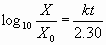
In the formula
X= the initial mass of the sample, Xo= the mass of the sample after the time of decay t, and k = 1.537×10⁻¹⁰ for U-238 when t is in years. Using this formula find (2) the mass, Xo, decayed over 106 years. Then, from calculations (1) and (2), find (3) the number of atoms in a mole.
Close window to continue.