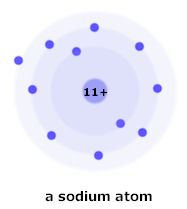
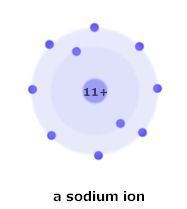
Cations are atoms that have lost an electron to become positively charged. Sodium has one valence electron, one electron in its outer energy level, so tends to lose one electron, and to become an ion with a +1 charge. The same could be observed for lithium, potassium, rubidium, caesium and francium. Magnesium, along with the other elements in group 2 of the periodic table, has two valence electrons, so tends to become an ion with a +2 charge. Aluminium tends to become +3.
What about the transition metals like lead, copper, tin and manganese? (Check the location of these on your periodic table.) Electrons in the transition elements are packed in a way that, generally, places the additional electrons inside the outer energy level. Iron has six more electrons than calcium, but the additional electrons have less energy than the two on the outer. The transition elements tend to have either one or two loosely held (valence) electrons. The six electrons present in iron but absent in calcium are held much less loosely than those in the next level down, but more tightly than those in the outer level. Having removed two electrons from both iron and calcium, removing a third electron would be much, much, much harder from calcium than from iron, since calcium's next electron is both more tightly held (a lower energy level) and in a complete shell.
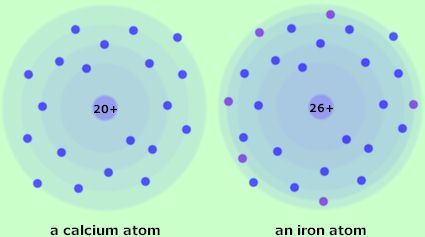
Because of this ambiguity in the transition elements, it is sometimes hard to predict the charge for their corresponding cation. Copper, for example, frequently loses two electrons (Cu2+), but copper ions with a +1 charge (Cu+) are also well known. Tin most often looses two (Sn2+), but frequently loses four (Sn4+). Iron can lose two or three. Manganese? So many choices you don't want to know.
For our purposes you will be able to tell which ion you are dealing with by the context it occurs in. You may be given the name of the ion. Sn2+ is named tin(II) [pronounced "tin-two"]. Pb4+ is named lead(IV).
You may be given a formula including the ion. FeCl2 is called iron(II) chloride [iron two chloride], containing Fe2+. (Each of the chlorides have accepted one electron, similar to other Group VII elements.) FeCl3 is called iron(III) chloride, containing Fe3+.
There are many other clues, but they are beyond the scope of this year's study.
The naming of cations is easy. Use the name of the element from which it was derived.
The more frequently encountered cations are listed on the Table of Common Ions.