So far our discussion has been restricted to hydrocarbons. Can carbon make bonds with other elements? Obviously, it can. We are all well acquainted with CO, CO2, the carbonate and hydrogen carbonate ions, cyanide (CN-), carbon tetrachloride (CCl4, and hence, not its proper name, as we shall see) and, hopefully to a lesser degree, CS2 (nasty stuff). While carbon is not totally restricted to making covalent bonds with other non-metals, these are certainly by very, very far the most common.
In line with keeping to simple cases, we want to look a bit more at the halogens. (Remember them?) I will use chlorine in these examples, but fluorine, bromine or iodine can be freely substituted with no loss of accuracy.
|
|
|
|
Here we see chloromethane, dichloromethane, trichloromethane and tetrachloromethane. The latter two have, in times gone by, been known as chloroform and carbon tetrachloride respectively.
|
||||||||||||||||||||||||||||||||||
 |
 |
|||||||||||||||||||||||||||||||||
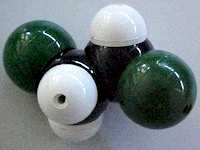
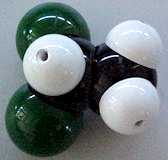
Problem 12. Here we have two isomers of dichloroethane. What are their systematic names?
Problem 13. Explain what is wrong with each of the suggested names for this structure:
|
Cl
|
H
|
H
|
H
|
|||
|
|
|
|
|
|
|
|
|
|||
|
C=C-C=C-C-C-H
|
||||||
|
|
|
|
|
|
|
|
|
|
|
||
|
H
|
H
|
H
|
H
|
H
|
||
- 6-chlorohex-3,5-diene,
- 1-chlorohex-diene,
- 1-chloro-4-ethylbut-1,3-diene.
Give a better name.
Next page: Reactions