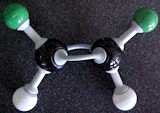
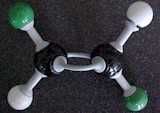
Cl Cl Cl H
\ / \ /
C=C C=C
/ \ / \
H H H Cl
Naming Alkanes - Part 2
Previous:First Naming Rules
One last fundamental rule can be applied if we look at an isomer of C8H18.
| CH3 | |||
| | | |||
| CH2 | |||
| | | |||
| CH3-CH2-CH--CH-CH3 | |||
| | | |||
| CH3 | |||
This is 3-ethyl-2-methyl pentane. The rule in question is how to order different side-branches. The answer is alphabetically, sort of. Ethyl comes before methyl, but it also comes before dimethyl, because the di- and other number prefixes are not taken into account. So
Rule 5) Side-branches are alphabetised by branch name, ignoring the number prefix.
Sometimes other elements or groups of elements are substituted for one or some of the hydrogen atoms. The rules apply apply to these substituents as well as to side-branches. CH3Cl is chloromethane.
| CH3-CH2-CH2-Cl CH3-CH-CH3 | |
| | | |
| Cl | |
These are 1-chloropropane and 2-chloropropane respectively.
Consider 2,3-dimethyl butane
|
| CH3 | |
| | | ||
| CH3-CH-CH-CH3 | ||
| | | ||
| CH3 | ||
There are only two possible positions to add a chloride:
You can end up with either 1-chloro-2,3-dimethyl butane or 2-chloro-2,3-dimethyl butane. Any other position is equivalent to one of these.
|
| ||||||||||||||||||||||||||||||
For 2,2-dimethyl butane try substituting a chloride on carbons 1, 2, 3 and 4. (Notice that three different carbons count as carbon 1.)
Note that what has been shown for chlorine is just as valid for fluorine, bromine and iodine, which leads to some highly interesting "simple" alkanes.
| Cl | |||
| | | |||
| CH2 | |||
| | | |||
| CH2 | F | ||
| | | | | ||
| CH3-CH2-C----CH---CH | |||
| | | | | | | |
| CH3 | CH3 | Br | |
Rule 1- find the longest chain of carbons. There are three 5-carbon chains. Starting with the right carbon we can gofour left or two left and two up. Or starting with the left carbon we can go tworight and two up. No difference, so far. We have some sort of pentane.
Rule 2 - identify any side chains and substituents: ethyl, methyl, fluoro, bromo and chloro will be in the name.
Rule 3 - the methyl occurs twice, so dimethyl will be in the name.
Rule 4 - locate the carbon for the side chains and substituents giving the lowest possible numbers: 3-ethyl, 2,3-dimethyl, 5-chloro, 1-bromo and 1-fluoro. Notice that in order to get the simplest name (not to have to figure out how to name fluoro and bromo on an ethyl side chain) I have chosen to count the five-carbon main chain as left two and up two.
| | | |||
| CH2 | |||
| | | |||
| CH2 | |||
| | | |||
| - | C---CH---CH | ||
| | | | | | | |
Rule 5 - alphabetise.
1-bromo-5-chloro-3-ethyl-1-fluoro-2,3-dimethylpentane.
It is not
So much for alkanes.
Actually, for alkenes and alkynes you need to add only two conditions.
First, before any of the other rules are applied, the double or triple bond must be part of the main chain.
|
|
| ||||||||||||||||||||||||||||||||||||||||||||||||||||||||||||
So here we have two versions of 2,3-dimethylbut-1-ene and one of 2,3-dimethylbut-2-ene. It’s easy when you have only one double (or triple) bond, though it can get a bit curlier with more. Note that the location of the double bond is placed before the –ene or –yne. Note also that it refers to the bond position, ie first bond in the chain, second bond, etc. And, yes, if there were two double bonds in the chain, you would have a –diene as in but-1,3-diene.
The second condition results from the real world observation that the free twisting and turning about single bonds is not present with double bonds. Thus these two molecules have slightly different chemical properties.
| Cl Cl Cl H \ / \ / C=C C=C / \ / \ H H H Cl | |
| |
For your information, the first is cis-1,2-dichloroethene, the second is trans-1,2-dichloroethene.