Previous Page: Predicting Bond Type
We have now discussed in this course three types of bonds (metallic, ionic, covalent) leading to four types of substances (metallic, ionic, network, molecular). How do the properties of these types of bonds compare to each other?
Ionic and covalent bonds are the two ends of a scale. The scale measures how evenly or unevenly the electrons are shared. Very equal sharing produces a very covalent bond. Very unequal sharing produces a very ionic bond. Metallic bonds are something else, as we have seen.
Recall also that of the four types of substances, only the molecules have a precise atomic count. The formulae for all the others reflects only the ratio of atoms present (the empirical formula), not the actual number. Atoms in metallic, ionic and network substances are packed into formation. This formation is sometimes called the crystal or lattice structure. The arrangement of these atoms defines the shape of their crystals.
Covalent bonds are strongest. The shared electrons are actually holding the two nuclei together fairly directly. Ionic bonds are weaker, but not much. They become weaker gradually as the degree of sharing decreases and the degree of donating increases. Electrons in FO2 are shared fairly evenly, so F-O bonds would be nearly as strong as F-F bonds. The electrons in NaF are mostly donated, giving a weaker bond.
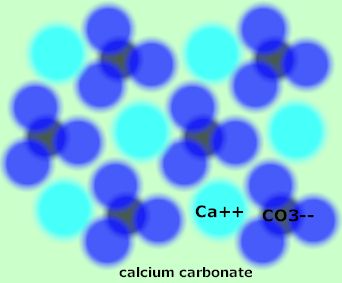
This suggests an explanation as to why compounds containing a polyatomic ion (eg. CaCO3) act as ionic compounds (eg. Ca2+ + CO32-) even though the bonds within the polyatomic ion (eg. C-O) are covalent.
Both covalent and ionic bonds are far stronger than metallic bonds. This should not be surprising when you think about the ambiguous nature of pooled electron ownership.
How do these differences affect the physical properties of these substances?
Next Page: A Summary of Bond Types
Related Topic: Two Kinds of Covalent Compounds